

Processing Technologies and Equipment
For substrate producers or growers who want to manufacture their own substrate components, there are more options today than ever before, with new technologies entering the market each year. Figure 1 provides a partial list of companies specializing in wood, bark, and other biomass processing machinery and technologies. Most sell equipment internationally and maintain offices, production facilities, and distribution centers across Europe and North America, and to a lesser extent, Asia and South America.
Most manufacturers supply versions of disc-refiners (defibrators) and screw processors (extruders, bioextruders, retruders, pressafiners), the two most common methods for producing wood fiber substrate materials. Figure 1 also includes several U.S. companies that sell hammer mill systems (fixed, swing, knife, crusher, etc.), a processing approach currently used more often in the U.S. than in Europe for substrate production.
It is also worth noting that many substrate processing machines in operation are not new turnkey systems. Many have been custom- built or retrofitted by substrate companies over time, and some, based on personal observation, are decades old and still operating.
Wood Product Suppliers
Since engineered wood fiber substrates emerged in Europe in the late 1970s, the number of growing media suppliers offering wood products has increased exponentially, especially over the past five to seven years. Many suppliers have produced wood fiber for decades, while others have recently invested in their own fiber production facilities rather than sourcing from third parties. Some European substrate suppliers now operate multiple wood fiber units at one or more production sites to reduce transport costs and take advantage of regional forest and biomass resources.
Beyond Loose-Fill: New Wood Substrate Formats
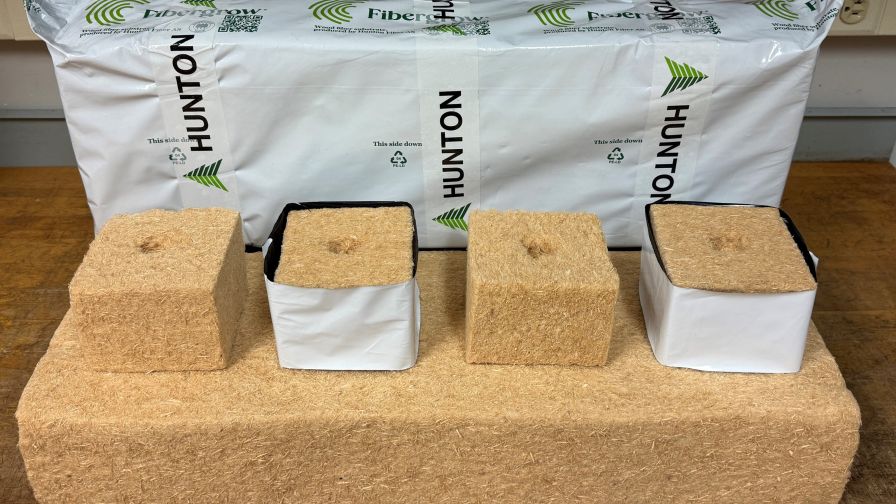
Driven by advances in wood processing and increased demand for wood-based substrates, new products are entering the market beyond loose-fill fiber. Fibergrow slabs and grow blocks (produced by Hunton in Norway) are one example, though not the first. Similar wood slabs were used in European greenhouse vegetable production in the late 1980s and 1990s as alternatives to stone wool.
Other companies are offering propagation cubes and grow mats made entirely of wood fiber, as well as compressed blocks that can be hydrated and expanded, like coir products. Additional prototypes are in development and, once commercialized, should provide growers with more options and production solutions.
Global Perspectives on Growing Media Security
Year-to-year fluctuations in substrate supply, combined with some peat reduction efforts worldwide, have brought scientists and industry leaders together to assess current limitations on substrate availability and identify barriers to future substrate development. While attending the ISHS Growing Media Symposium in Germany last September, I participated in a workshop on “Emerging Limitations to Growing Media Security (2025–2035),” which included experts from academia, industry, NGOs, and policy circles. The workshop, coordinated and led by Dr. Beatrix Alsanius (Sweden), focused on six overarching concepts shaping the future of growing media and soilless crop cultivation:
- Climate and environmental stressors
- Political and regulatory constraints
- Market and economic factors
- Resource scarcity and supply-chain fragility
- Quality, performance, and technical challenges
- Knowledge, innovation, and transition gaps
Workshop discussions suggested that geopolitical uncertainties, limited market access to peat alternatives, and the lack of investment in soilless substrates can create “barriers to transition” for many growers.
Many of these issues are realities in the U.S. as well. To solve a problem, you first must understand it and identify practical paths forward. That work is underway through research, interdisciplinary collaborations, and support from governmental and private sector organizations. The shift toward wood fiber and other peat alternatives is being advanced through global research efforts led by public and private groups and substrate companies.
If the pace and scale of wood fiber and other alternative material development and adoption over the past five years continue, it is reasonable to conclude that growing media may be nearing a transition the industry has not experienced since the move to peat more than half a century ago. The continued responsible use of peat, alongside wood fiber and other materials, will likely be part of the long-term solution for how we feed and beautify the world for decades to come.
If you are the copyright owner and wish to request removal, please contact: woodworkersnews@gmail.com.