Maine’s forest industry is adapting. A new snapshot breaks down where it stands.
PORTLAND, Maine – Maine’s forest industry has been one of the state’s biggest economic drivers for nearly four centuries.
Today, it supports about 29,000 jobs across all 16 counties and contributed an estimated $8.3 billion to Maine’s economy in 2024.
But the latest assessment shows employment is down 7%, with the biggest losses in paper and logging.
A new report by the Maine Forest Products Council, backed by the University of Maine, offers the first full snapshot of the industry in more than six years. It outlines both the challenges and the opportunities shaping Maine’s forest economy.
A legacy rooted in Maine
Maine is known as the Pine Tree State for a reason.
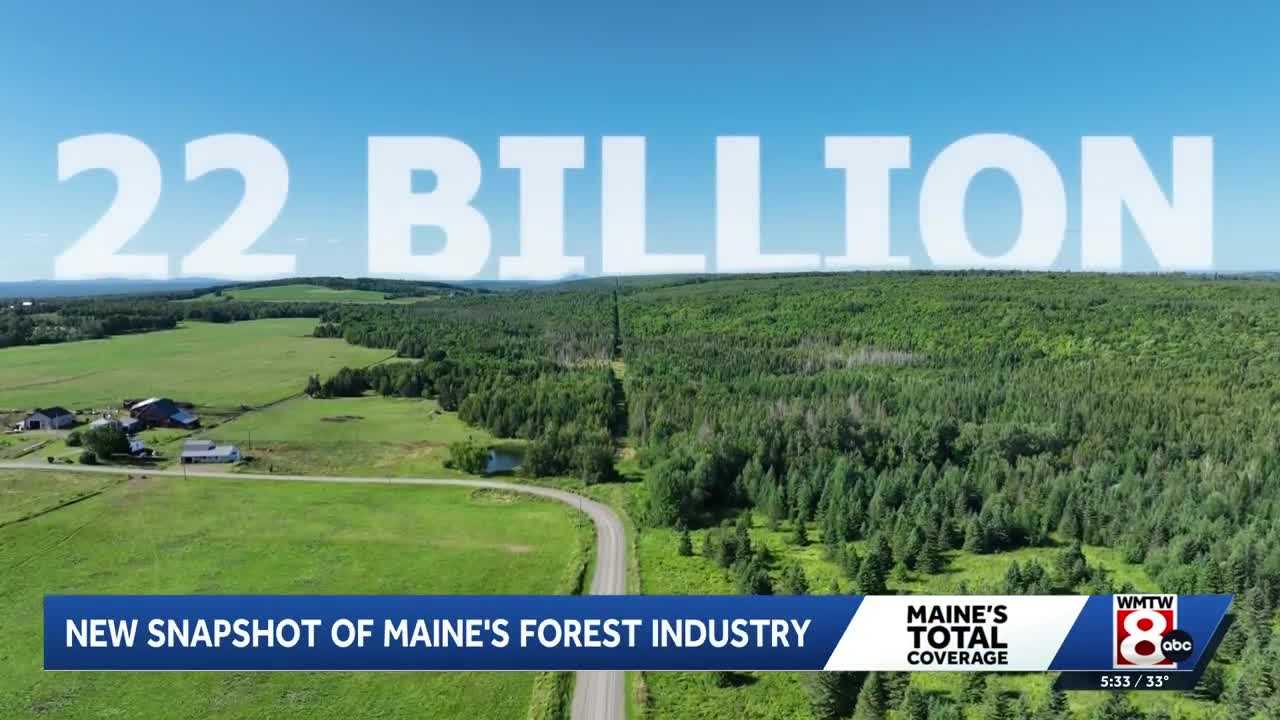
Maine’s forests currently contain more than 22 billion live trees, making it the most forested state in the nation and powering an industry long central to its economy. That legacy dates back to 1634, when Maine’s first official sawmill began operating in South Berwick.
Now, industry leaders are stepping back for a statewide look at where the forest products sector stands and where it’s headed.
“We usually do it in closer increments. But this last time, we kept having really unusual, unpredictable, highly disruptive events happening,†said Krysta West of the Maine Forest Products Council.
Those disruptions include the global pandemic and a string of major challenges.
“Multiple 100-year storms that were highly disruptive to our operations and unprecedented inflation and other driving factors that are just so unusual and disruptive and outside of our control that we kept pumping the brakes and saying, ‘Well, we’ll let things settle out for another year before we run the numbers,’†said Krysta West of the Maine Forest Products Council.
West said the report includes some unexpected findings.
Paper sales decline 41%
One of the most significant findings: Paper manufacturing sales are down 41% across Maine. The figure does not include Sappi’s PM2 upgrade and expansion.
The explosion at the Pixelle paper mill in Jay is part of the story. So is a global shift in how paper is used.
“So, for, for, you know, shifting away from printing and writing paper, yes, that’s on the decline, and that’s not coming back,†said West.
At the same time, West said new regulations and incentives for recyclable and compostable packaging are creating opportunities.
“So we’re, we’re doing tissue paper and toilet paper and paper towels. We’re doing Sappi. They’re doing everything from the labels that are on cans to packaging products for, for, food, food, contact-type packaging. And then over in nine Dragons in Rumford, they’re manufacturing, like, the white paper bags that are used for like, Dunkin’ Donuts bag or Chick-fil-A bag, that type of product as well,†said West.
Wood product sales up 45%
While paper sales are down, wood product manufacturing has been growing.
Statewide, wood product manufacturing sales are up 45%.
At Pleasant River Lumber, investment is driving that growth.
“Yeah. I mean, since 2018, we’ve put in about 100 now, probably $80 million on this site alone. Yeah. We had a small planer mill planing some production from Dover, but we’ve since changed that out. And everything you see in back of us here is new,†said Chris Brochu of Pleasant River Lumber.
The company is expanding production.
“We have plans of adding a second shift here,†said Jason Brochu of Pleasant River Lumber.
Diversifying for the future
West said growth is also coming from emerging categories, helping diversify the industry. One of those categories has now doubled in growth.
“So, the other category would be things like the wood fiber insulation that’s gone into the shuttered Madison Mill. It would be molded fiber products, which, again, are going to be really important for paper packaging and food contact stuff going forward. It would also be things like smart side, which is manufactured about LP and Aroostook County,†said West.
With much of Maine’s natural wealth rooted in its forests, industry leaders say staying viable means adapting traditional sectors and finding new ways to compete.
The goal is to keep Maine’s forest economy as healthy as the forests themselves.
If you are the copyright owner and wish to request removal, please contact: info@woodworkersnews.com.