

According to the latest IndexBox report on the global Particle Board market, the market enters 2026 with broader demand fundamentals, more disciplined procurement behavior, and a more regionally diversified supply architecture.
The global particle board market, a cornerstone of the engineered wood products industry, is navigating a period of strategic evolution as it approaches the 2026-2035 forecast horizon. Characterized by its efficient utilization of wood residues and cost-effective production, particle board remains indispensable for mass-produced furniture, interior construction, and packaging. This analysis projects a market transitioning from traditional volume-driven growth to a more nuanced path defined by regional demand shifts, technological advancements in board performance, and intensifying sustainability mandates. Growth through 2035 will be underpinned by sustained construction activity in emerging economies and the material’s fundamental role in affordable furniture and interior fit-outs. However, the trajectory is recalibrated against pressures such as volatile raw material costs, competition from alternative panels, and evolving environmental regulations affecting resin chemistries. This report provides a comprehensive, data-driven assessment of these dynamics, segmenting demand across key applications, evaluating regional production and consumption patterns, and identifying the strategic imperatives for manufacturers, distributors, and investors operating in this globally traded commodity market.
The baseline scenario for the global particle board market from 2026 to 2035 anticipates moderate, steady expansion, supported by its entrenched position in cost-sensitive applications but tempered by maturity in key developed regions and competitive pressures. The market is expected to grow at a compound annual growth rate (CAGR) in the low-to-mid single digits, translating to a significant cumulative volume increase by 2035. This growth is fundamentally linked to global urbanization trends and disposable income levels, which drive residential construction and furniture purchases. The Asia-Pacific region will remain the dominant engine of consumption and production, though its growth rate may moderate compared to the previous decade. Europe and North America will see demand shaped by renovation cycles and replacement demand, with a pronounced shift towards higher-value, specialty boards like moisture-resistant (MR) and fire-retardant (FR) grades. A key underlying assumption is the continued, albeit gradual, adoption of more stringent formaldehyde emission standards globally, which will compel capital investment in resin technology but also open opportunities for compliant producers. Supply chains are expected to remain regionally focused due to the bulky, low-value-to-weight nature of the product, with trade flows adjusting to regional capacity imbalances and tariff structures. Overall, the market outlook is for consolidation of gains rather than disruptive change, with profitability increasingly tied to operational efficiency, product diversification, and sustainability credentials.
Demand Drivers and Constraints
Primary Demand Drivers
- Sustained urbanization and residential construction activity in emerging economies, particularly in Asia-Pacific.
- Cost-advantage over solid wood and other engineered wood panels in mass-produced furniture and cabinetry.
- Efficient utilization of wood residues and recycled fiber, aligning with circular economy principles.
- Technological advancements leading to improved board properties (moisture resistance, fire retardancy, strength).
- Growth in the ready-to-assemble (RTA) furniture segment and e-commerce furniture delivery.
- Renovation and remodeling cycles in mature housing markets of North America and Europe.
Potential Growth Constraints
- Volatility in raw material (wood chip, resin) and energy costs impacting production margins.
- Stringent and evolving environmental regulations on formaldehyde emissions (e.g., CARB, REACH).
- Competition from substitute products like Medium Density Fiberboard (MDF) and plywood in certain applications.
- Market maturity and saturation in key developed regions, limiting volume growth potential.
- Logistical challenges and high transport costs due to the product’s bulk and low value density.
Demand Structure by End-Use Industry
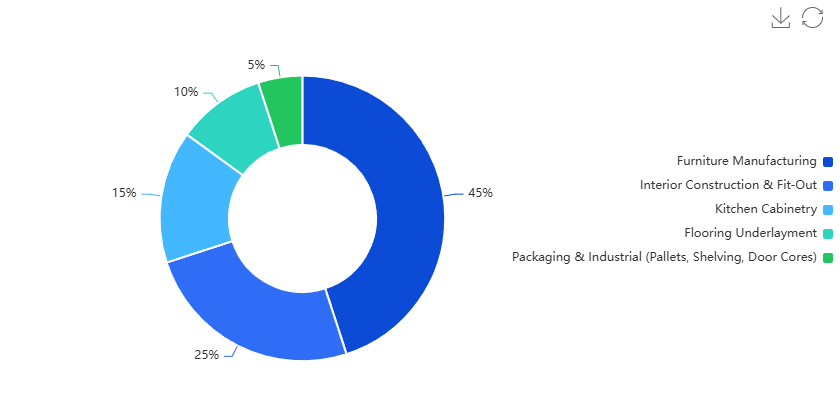
Furniture Manufacturing (estimated share: 45%)
Furniture manufacturing is the largest and most established end-use for particle board, primarily for case goods, shelving units, bed frames, and desk cores. The segment’s demand is directly tied to consumer spending on home furnishings, new household formation, and the health of the real estate market. Through 2035, the core mechanism remains the material’s unbeatable cost-to-performance ratio for concealed structural components and substrates for laminates. Key demand-side indicators include furniture retail sales, housing starts, and disposable income levels. The trend is not towards volume explosion but a qualitative shift: increasing adoption of laminated particle board (melamine-faced) for visible surfaces in ready-to-assemble (RTA) furniture, driven by e-commerce. Demand will also be influenced by furniture design trends favoring lighter, modular units which utilize engineered panels efficiently. Growth will be strongest in regions with expanding middle-class populations, while mature markets will see demand driven by replacement and style refresh cycles. Current trend: Stable core demand with shift towards value-added, laminated boards..
Major trends: Rise of e-commerce and flat-pack furniture supply chains demanding consistent, machinable board quality, Increased use of digital printing and textured laminates on particle board substrates for aesthetic differentiation, Focus on lightweight designs to reduce shipping costs, favoring optimized panel engineering, Integration of furniture manufacturers with panel producers for just-in-time supply, and Growing demand for formaldehyde-free or ultra-low emitting boards in consumer-facing furniture.
Representative participants: IKEA, Ashley Furniture Industries, HNI Corporation, Steelcase, Herman Miller, and Godrej & Boyce.
Interior Construction & Fit-Out (estimated share: 25%)
This sector encompasses wall paneling, ceiling linings, partition walls, and built-in storage in both residential and commercial construction. Demand is cyclical, correlated with construction investment, office fit-out activity, and retail refurbishment rates. The critical mechanism is particle board’s role as a cost-effective substrate and core material where structural loads are minimal. Through 2035, growth will be propelled by the specification of performance-grade boards. Moisture-resistant (MR) board demand is driven by its use in kitchens, bathrooms, and basements in residential projects and high-humidity areas in commercial buildings. Fire-retardant (FR) board adoption is mandated by building codes for specific applications in commercial and multi-family residential structures, creating a stable, regulation-driven demand stream. Key indicators include non-residential construction spending, building permit data, and the stringency of regional building codes regarding fire safety and indoor air quality. Current trend: Growing demand for specialized performance grades (MR, FR) in non-residential applications..
Major trends: Stringent building codes elevating demand for certified fire-retardant (FR) particle board, Growth in open-plan office and commercial interiors requiring demountable partition systems using panel cores, Rise of modular construction methods utilizing pre-fabricated panelized components, Increased use of MR board in wet-area applications due to improved resin technology, and Focus on acoustic paneling in offices and multi-unit dwellings, where particle board serves as a core material.
Representative participants: Turner Construction, Skanska, DPR Construction, AECOM, Gensler, and Jacobs.
Kitchen Cabinetry (estimated share: 15%)
Kitchen cabinetry represents a high-volume, specification-sensitive application. Particle board is the dominant substrate for cabinet boxes (carcasses) due to its dimensional stability, smooth surface for laminate adhesion, and low cost. Demand is driven by new housing construction, kitchen remodeling activity, and the replacement cycle for existing cabinets. The mechanism through 2035 involves a dual track: continued high-volume use of standard and MR-grade boards for economy and mid-range cabinet carcasses, coupled with growth in the use of pre-finished, edge-banded laminated boards for higher-end lines. Demand-side indicators include housing starts, kitchen and bath remodeling indices, and consumer confidence. The trend towards larger kitchens and more cabinetry per home supports volume, while design trends favoring sleek, laminated finishes support value. Competition from MDF for painted cabinet doors remains a factor, but particle board retains its core advantage for box construction. Current trend: High-volume substrate use with premiumization driving laminated and finished board demand..
Major trends: Dominance as the primary carcass material for stock and semi-custom cabinetry lines, Growth in demand for pre-laminated and pre-edged boards to reduce cabinet shop processing time, Increased specification of MR-grade board for base cabinets in contact with floors, Consolidation among large cabinet manufacturers driving standardized panel sourcing, and Consumer demand for soft-close hardware, which performs well on particle board substrates.
Representative participants: MasterBrand Cabinets, American Woodmark, Wellborn Cabinet, Nobia Group, Haas Cabinet Company, and SieMatic.
Flooring Underlayment (estimated share: 10%)
Particle board, particularly flooring-grade panels, is used as an underlayment to provide a smooth, stable surface over wood or concrete subfloors before installing finished flooring like vinyl, laminate, or carpet. Demand is almost entirely tied to flooring installation and replacement activity in both new construction and renovation. The mechanism is non-discretionary; when a new floor is installed, an underlayment is typically required. Through 2035, demand will follow the cycles of residential and commercial construction and remodeling. Key indicators are flooring retail sales, remodeling permits, and commercial tenant improvement activity. Growth is steady but limited by competition from alternative underlayment materials like plywood and cement board in moisture-prone areas. The segment is characterized by high volume but very low margin, competing primarily on price and consistent panel thickness. Current trend: Stable, replacement-driven demand linked to flooring installation cycles..
Major trends: Essential component in floating floor installations for laminate and engineered wood flooring, Competition from oriented strand board (OSB) and plywood in certain geographic markets and applications, Demand for higher-density, smoother-surface underlayment grades to prevent telegraphing, Link to the DIY/home center retail channel for repair and remodel projects, and Specification driven by flooring manufacturers’ installation guidelines.
Representative participants: Shaw Industries, Mohawk Industries, Tarkett, Mannington Mills, Armstrong Flooring, and Home Depot (as retailer).
Packaging & Industrial (Pallets, Shelving, Door Cores) (estimated share: 5%)
This aggregated sector includes the use of particle board for heavy-duty shelving units in warehouses and retail, disposable packaging for sensitive goods, pallets for light loads, and as a core material for flush doors. Demand is driven by industrial activity, logistics expansion, and commercial fit-out. The primary mechanism is cost minimization for non-aesthetic, functional applications where the board’s properties are sufficient. For door cores, particle board provides a flat, stable, and inexpensive substrate for veneers. Through 2035, demand will correlate with manufacturing output, warehouse construction, and global trade volumes (for packaging). It is a highly price-sensitive segment where particle board competes with lower-grade plywood and, increasingly, plastic alternatives for pallets. Growth is modest and tied to overall economic expansion rather than consumer trends. Current trend: Niche, cost-driven demand in industrial and protective applications..
Major trends: Use in blockboard construction for lightweight interior doors, Application in heavy-duty industrial shelving systems where load-bearing capacity is engineered, Competition from molded plastic and corrugated solutions in protective packaging, Demand linked to e-commerce fulfillment center expansion requiring storage solutions, and Replacement market for commercial shelving and storage systems.
Representative participants: Uline, Inter IKEA Systems (packaging), Jeld-Wen (doors), Masonite (doors), CHEP (pallets), and Brambles (pallets).
Key Market Participants
| # | Company | Headquarters | Focus | Scale | Note |
|---|---|---|---|---|---|
| 1 | Kronospan | Luxembourg | Full range wood panels | Global leader | Major particle board producer |
| 2 | Swiss Krono Group | Switzerland | Wood-based panels | Global | Large particle board capacity |
| 3 | West Fraser Timber Co. Ltd. | Canada | Wood products | North America | Major integrated producer |
| 4 | Roseburg Forest Products | USA | Engineered wood products | North America | Key US particle board maker |
| 5 | Kastamonu Entegre | Turkey | Wood-based panels | Global | Large integrated panel producer |
| 6 | Arauco | Chile | Forest products | Global | Significant panel producer |
| 7 | Duratex | Brazil | Wood panels | Americas | Leading in Latin America |
| 8 | Pfleiderer Group | Germany | Engineered wood panels | Europe | Specialist in particle board |
| 9 | Egger Group | Austria | Wood-based materials | Global | Decorative particle board |
| 10 | Norbord (West Fraser) | Canada | OSB, particle board | Global | Now part of West Fraser |
| 11 | Sonae Arauco | Portugal | Wood-based panels | Global | Joint venture, major player |
| 12 | Georgia-Pacific | USA | Building products | North America | Particle board under GP Wood Products |
| 13 | Boise Cascade | USA | Wood products, distribution | North America | Engineered wood products |
| 14 | Louisiana-Pacific | USA | Building products | North America | OSB focus, some particle board |
| 15 | Finsa | Spain | Wood panels | Europe | Spanish leader in panels |
| 16 | M. Kaindl | Austria | Wood-based panels | Europe | Specialist producer |
| 17 | Tafisa | Canada | Particleboard, laminate | North America | Particle board specialist |
| 18 | Dynasty | Canada | Particleboard, MDF | North America | Canadian panel producer |
| 19 | Panel Rey | Mexico | Wood panels | Americas | Leading Mexican producer |
| 20 | Greenply Industries | India | Plywood, MDF, particle board | India | Leading Indian panel maker |
| 21 | Century Plyboards | India | Plywood, MDF, particle board | India | Major Indian integrated player |
| 22 | Associate Decor | India | Particle board, laminates | India | Significant Indian producer |
| 23 | Sveza | Russia | Birch plywood, panels | Russia | Large Russian wood panel company |
| 24 | Kalevala | Russia | Wood-based panels | Russia | Russian particle board producer |
Regional Dynamics
Asia-Pacific (estimated share: 55%)
Asia-Pacific will consolidate its position as the dominant production and consumption region, accounting for over half of global volume. Growth, though moderating from previous highs, will be driven by sustained urbanization, infrastructure development, and a robust furniture manufacturing sector, particularly in China, India, and Southeast Asia. The region also hosts major exporting nations, shaping global trade flows. Direction: Growth Leader.
Europe (estimated share: 22%)
Europe represents a mature, high-volume market characterized by stringent environmental regulations and a focus on high-value, specialty boards. Demand will be stable, primarily driven by renovation activity, furniture replacement, and compliance-driven upgrades to low-emission products. Regional production is advanced and integrated, with significant intra-European trade. Direction: Mature & Stable.
North America (estimated share: 15%)
The North American market is well-established, with demand closely tied to housing starts and remodeling activity. Growth will be moderate, supported by population growth and commercial construction. The market is bifurcated between commodity particle board and the dominant Oriented Strand Board (OSB) segment, which is largely used in structural sheathing. Direction: Moderate Growth.
Latin America (estimated share: 5%)
Latin America holds emerging potential, with Brazil being a significant regional producer and consumer. Market growth is linked to economic stability, construction sector development, and the expansion of the middle class. The region faces challenges from infrastructure and raw material supply but offers long-term growth opportunities. Direction: Emerging Potential.
Middle East & Africa (estimated share: 3%)
This region represents a smaller, nascent market. Demand is primarily driven by imported boards for construction and furniture projects in Gulf Cooperation Council countries and parts of North Africa. Local production is limited, and growth is tied to foreign investment in construction and economic diversification efforts away from oil dependency. Direction: Nascent Development.
Market Outlook (2026-2035)
In the baseline scenario, IndexBox estimates a 3.2% compound annual growth rate for the global particle board market over 2026-2035, bringing the market index to roughly 137 by 2035 (2025=100).
Note: indexed curves are used to compare medium-term scenario trajectories when full absolute volumes are not publicly disclosed.
This report provides an in-depth analysis of the Particle Board market in the World, including market size, structure, key trends, and forecast. The study highlights demand drivers, supply constraints, and competitive dynamics across the value chain.
The analysis is designed for manufacturers, distributors, investors, and advisors who require a consistent, data-driven view of market dynamics and a transparent analytical definition of the product scope.
Product Coverage
This report covers particle board, a manufactured wood panel product made from wood chips, sawmill shavings, or sawdust bonded with a synthetic resin or other suitable binder under heat and pressure. The analysis encompasses the global market, including production, consumption, trade, and key trends shaping the industry. It examines the material’s role across various downstream applications and its position within the broader engineered wood products sector.