
OMAHA, Nebraska – Discussions about pallet machinery investment often focus on faster lines, higher throughput, and the promise of doing more with fewer people. While those forces are undeniably shaping the market, some pallet companies are finding that the current economy places more emphasis on efficiency and cost control than on adding capacity.
After spending time with Steve Gallucci, CEO of Palleton Inc., it became clear that machinery and technology are not the starting point for the company’s decision-making. The more consistent driver behind Palleton’s evolution has been discipline in how it operates, how it serves customers and how it invests.
That discipline is rooted in the company’s origins and in the values established by founder Larry Meyer, who launched the business in 1980. Although the company has expanded significantly since then, this foundational mindset continues to influence how Palleton evaluates growth opportunities, approaches automation and balances efficiency with service.
“Larry started this company by himself,” Gallucci said. “One thing he was always clear about is that he would serve his customers with honesty and never put his name on a product he wasn’t proud of. That’s never changed.”
Those modest beginnings help explain why Palleton has remained cautious about overextending itself. Its management team has been selective in its equipment investments and focused on building systems that support long-term stability and sustainable customer relationships.
From Pickup Truck to Regional Network
Palleton began in Omaha, Nebraska, in 1980, when founder Larry Meyer and many other employees were laid off from Union Pacific Railroad. At the suggestion of a co-worker, Meyer began refurbishing pallets as a temporary source of income, working out of the back of a pickup truck with a hammer and nails. What started as a stopgap income source quickly turned into a viable business.
Over the following decades, the company expanded steadily, guided by customer demand and a practical approach to growth. Today, Palleton operates a multi-site pallet and wood packaging network with a strong footprint across the Midwest. Its operations include multiple pallet manufacturing and recycling facilities, sawmills supplying internal cut-stock production, dedicated custom packaging operations, and a trucking business that supports both internal logistics and customer deliveries.
The company offers a range of standard and custom new pallets using SPF, SYP, and hardwood material. It also offers combos, recycled pallets, and specialized wood packaging. More than anything, Palleton looks to help customers eliminate pallet headaches.
“We’re not just a pallet manufacturer,” Gallucci said. “We spend a lot of time solving problems for customers by looking at how pallets are actually being used, simplifying SKUs, meeting specifications, and eliminating issues that cost time and money.”
The company’s core manufacturing presence is concentrated in Nebraska, Iowa, Kansas, Missouri and Minnesota. In addition, Palleton operates a national pallet brokerage business. This allows the company to support customers with facilities across the country through a centralized point of coordination. Palleton’s brokerage operation is led by Jason Kaiser, and it is increasingly important for customers seeking consistency across multi-location pallet programs.
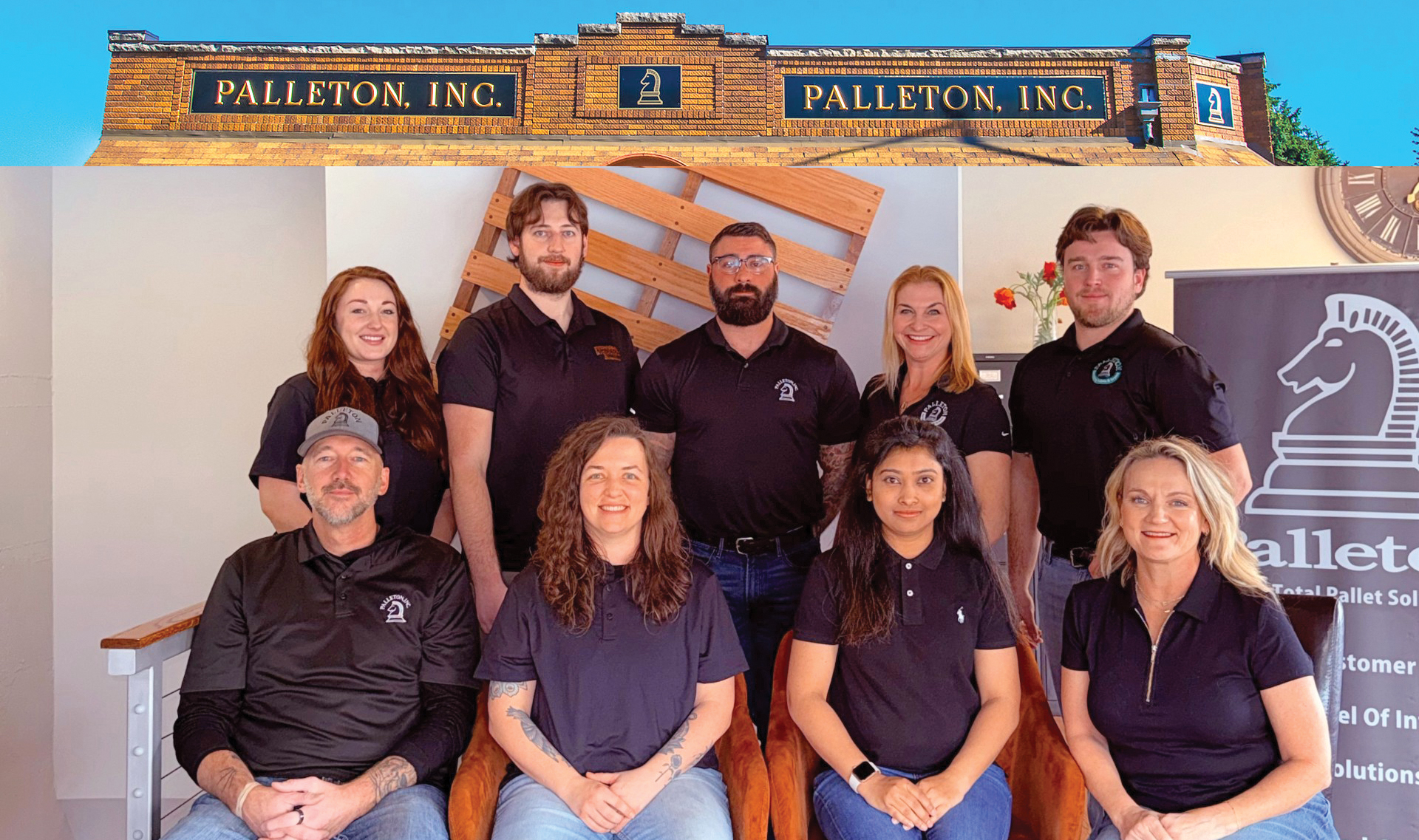
Through 15 related business entities, Palleton employs approximately 130 people. Ownership remains closely held. Meyer is still the majority owner, with his daughter, Lacy Arteaga, vice president of sales, holding a minority stake. Meyer remains actively involved, reviewing financials and consulting on business matters on a near-daily basis.
Coordinating a Multi-Site Operation Without Losing Flexibility
As pallet companies add locations, one of the first pressures to emerge is communication. Decision-making can slow, accountability can blur, and customer responsiveness often suffers as organizations become more complex. Palleton has taken a deliberate approach to avoid those pitfalls by pairing centralized standards with local authority at the plant level.
Since joining the company six years ago, Gallucci has led an effort to standardize processes, policies and reporting across all facilities, while still allowing facility managers to make real-time operational decisions.
“All of our policies, procedures, and protocols come from headquarters,” Gallucci said. “But our facilities still have autonomy to make decisions on the fly. That’s how we solve customer problems quickly.” In the Midwest in particular, Gallucci observed, those local customer relationships are still extremely important.
Each location operates under a defined hierarchy, with a facility manager responsible for day-to-day production, shipping and customer issues. Those managers work closely with centralized sales and logistics teams, using standardized operating procedures and shared data to coordinate production and capacity across the network. This hybrid structure supports one of the company’s core operational goals: resolving the vast majority of customer issues within six hours and closing every issue within 24 hours.
Technology plays a supporting role in making that model work. Palleton adopted Pallet Connect early and has customized the platform extensively to match its operating needs, particularly for multi-site coordination and its national brokerage operation.
“We signed on to Pallet Connect when it was almost brand new,” Gallucci explained. “We worked closely with them to build the reports and views we needed.”
Today, the system supports live production scheduling, order tracking, brokerage transactions, and billing across the organization. Orders move digitally from sales into production, while drivers use tablets to capture signatures and photos at delivery. That information feeds directly into invoicing and customer records.
“At any moment, I can see what every facility is doing,” Gallucci said. “If a customer calls with a question, we can tell them exactly when a load was delivered, who signed for it, and show photos from the dock.”
The result is fewer disputes, razor-accurate costing, faster billing and tighter operational control without sacrificing the local decision-making speed that customers continue to value.
Machinery Evaluation: “I Ask Four Questions”
Palleton runs a wide range of equipment across its sawmilling, manufacturing, recycling and material-handling operations. This includes Baker sawmills, Brewco resaw lines, package saws, M2L lumber stackers, pallet sortation equipment from Alliance Automation, Woodpecker and Rayco nailing machines, Rotochopper and Morbark grinders, along with notchers, dismantling saws, conveyors, and several machines that have been modified or designed internally to better fit specific workflows.
While the equipment base is extensive, Gallucci is clear that machinery decisions start with operational requirements, not technology trends.
“When I look at any piece of equipment, I ask four questions,” he noted. “How easy is it to use? How easy is it to repair? Can I source parts locally? And does it actually increase my production efficiency?”
If a machine does not meet those criteria, the decision is straightforward, regardless of how advanced it may appear. One of the company’s most successful machinery investments has been a pallet sort system from Alliance Automation. Palleton took a risk by being the first user of this system more than three years ago.
“Sorting pallets is hard, heavy work,” Gallucci commented. “A lot of injuries happen there. People get hurt; they miss work, or they’re less productive because they’re in pain.”
By shifting heavy lifting from people to machines, the sort system delivered results that extended beyond throughput.
“We’ve virtually eliminated sorting-based injuries,” Gallucci declared. “At the same time, we increased sorting capacity per shift and improved employee longevity and retention.”
But not every automation idea works in Palleton’s disciplined process. Gallucci acknowledged, “There are some very high-quality machines out there… But if it breaks and I have to fly in a technician from another state, and the line is down, that’s a no-go for us.”
This philosophy is one reason that Woodpecker nailing machines have become a standard across Palleton’s facilities, with nine currently installed. Gallucci explained, “Woodpecker machines have proven reliable over time and are designed in a way that allows most repairs to be handled on the floor by our staff.”
He added, “Most of the parts are standard – things we can source locally or get overnight.”
If something does go wrong, he noted, repairs can usually be made quickly without waiting days for a specialist to arrive. Supplier proximity plays a similar role in sawmilling operations. For example, at the company’s Missouri sawmill, Palleton relies heavily on equipment from Baker Products, in part because service support is close at hand.
“If something happens, they can drive to us,” Gallucci said. “That matters when you’re running mills every day.”
After COVID, Palleton added a Baker saw line to support high-volume, custom-sized lumber for our northern locations. Because the system had to fit within an existing building, visiting Baker Products in Missouri was invaluable. Gallucci explained, “Baker’s team worked closely with us to design a line that fit both our space and production needs. What sets Baker apart is the flexibility of their equipment and line configurations, which allows us to adapt as our business evolves. In an industry where conditions change quickly, that flexibility matters. As we said when I was in the U.S. Army, ‘Semper Gumby’—always flexible—and Baker Products helps us live that every day.”
Another key supplier for Palleton has been PRS Group, Inc. It has become the go-to supplier for many smaller machines, such as notchers, stackers, tippers, dismantlers, platers, trim saws and more. Gallucci stated, “PRS machines are simple but effective, offered at a good price point, and their customer service has always been top-notch.”
Having the right supplier is important even for consumable or component products. Palleton obtains a large amount of nails and pneumatic hand tools from Viper Industrial Products. Gallucci said, “In a production environment, even small supply issues can create major disruptions.” Viper’s ability to quickly respond to issues with nails or tools keeps Palleton’s nailers firing. He added, “Viper’s reliability, communication and commitment to quality make them a supplier we trust.”
Why Advanced Automation, Robotics and AI Are Not Automatically the Answer
Gallucci has spent time evaluating emerging automation and AI-enabled systems. While he remains interested in where those tools may eventually lead, he is candid about their current limitations in real-world pallet operations at Palleton.
“I’ve seen a lot of machines with advanced automation or AI built into them,” he acknowledged. “But a lot of times, I’m still seeing two guys running the machine.”
In practice, Gallucci said some systems add layers of complexity and maintenance cost without delivering meaningful gains in throughput or labor efficiency. From his perspective, technology has to solve a specific operational problem, not simply introduce a new one.
“If I still need the same number of people, and now it costs more to fix when something breaks, and I’m not building pallets any faster, then what problem did I solve?” he asked.
Saving Pallet Buyers Money
A major focus for Palleton is to save customers money. Gallucci explained, “We are starting to serve a new customer that is family-owned, national company that has faced pallet quality issues that have led to cost increases. After evaluating the situation, we determined the root cause and developed a tailored pallet solution. We committed to helping them reduce costs while supporting their continued growth.
The customer recently wrote after working with Palleton, “I was in a meeting going over pallet quality and customer complaints. We’ve seen a marked improvement in pallet quality. Both the manager and the team tracking customer complaints are reporting much better results. For our large international distributor, it appears we’ll receive a stronger score on the metrics that determine quarterly contract discounts.”
Gallucci predicted, “We are on schedule to save that customer somewhere in the ballpark of $250,000 for FY26 if things keep going the way we are planning.”
Custom Packaging as a Separate Discipline
In addition to high-volume pallet manufacturing, Palleton operates two dedicated custom packaging facilities focused on complex pallets and crates built to tight customer specifications. These operations are intentionally separated from standard pallet production, reflecting the very different demands of custom work.
“They’re almost two different industries,” Gallucci recognized. “The guys who work in our custom shops wouldn’t necessarily be good on a high-speed GMA line, and vice versa.”
Custom packaging at Palleton often involves large-format pallets, oversized crates, and highly engineered builds that require close coordination between design and production. Some projects include dozens of individual components, miter cuts, metal hardware, threaded rod, foam blocking and other mixed materials. In certain applications, tolerances can be as tight as one-eighth of an inch over an eight-foot span.
Much of that work remains manual by design. Gallucci said the economics of custom packaging do not lend themselves easily to full automation. This is particularly true when production runs are short and specifications vary widely from job to job.
“The margins don’t support full automation,” he said. “And honestly, the flexibility of skilled people is still the best solution.”
Rather than forcing automation into applications where it does not fit, Palleton treats custom packaging more like a fabrication or machine shop environment. It relies on experienced teams, disciplined processes and in-house engineering support to meet demanding requirements.
A Measured View of Consolidation and a Disciplined Path Forward
Gallucci remarked on the structural changes reshaping the pallet industry, particularly the surge of private equity investment during and immediately after COVID-19. In his view, a period of low interest rates and elevated pallet and lumber prices encouraged aggressive expansion that is now being tested by softer demand and higher borrowing costs.
“A lot of companies were bought at top dollar when rates were low,” Gallucci suggested. “Now rates are higher, demand is softer, and that debt doesn’t look so good anymore.”
Against that backdrop, Palleton has deliberately avoided overleveraging, choosing instead to preserve balance sheet flexibility and operational control. Gallucci said the company remains fully solvent and capable of meeting its obligations, even in a challenging market environment.
“We’re aggressive when there’s a targeted investment that makes sense,” he explained. “But we’re very frugal when it comes to non-targeted spending.”
This discipline extends beyond capital decisions. Rather than chasing scale for its own sake, Palleton has focused on investments that support maintenance reliability, operational resilience and long-term customer relationships. The same thinking that guides equipment selection and automation decisions also shapes how the company evaluates acquisitions, expansions and new business lines.
Larry Meyer, founder of Palleton commented, “I’ve been in this industry a long time. I’ve seen the high times and the low times. You never get too high, never get too low.”
If you are the copyright owner and wish to request removal, please contact: info@woodworkersnews.com.