

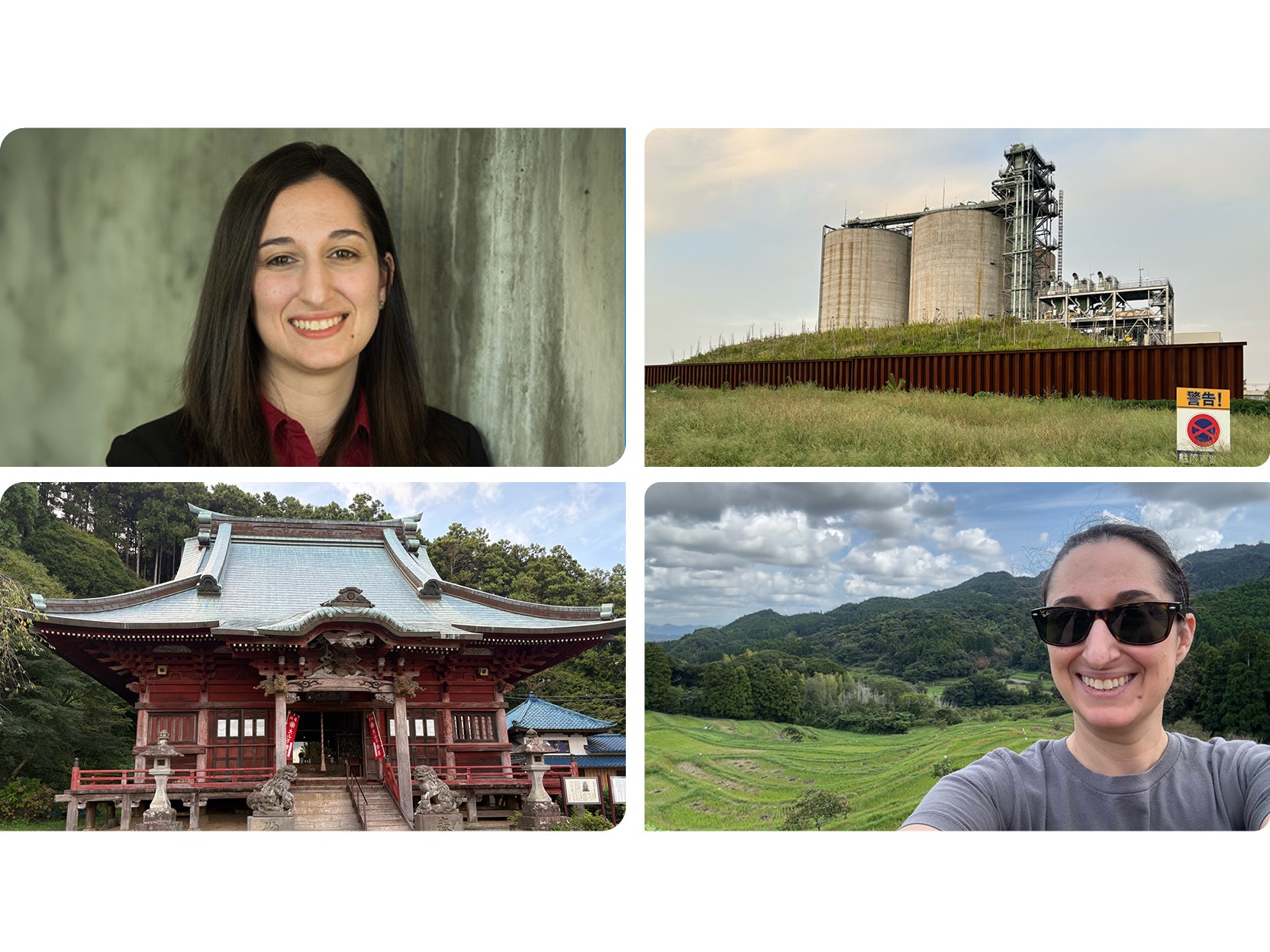
The SELC senior attorney is best known for her work on the front lines of the American South’s wood pellet industry, plus advising on biomass policy in Europe, the world’s largest importer of wood pellets.
However, after her most recent adventure, her influence has extended to Asia.
Teaming up with Mighty Earth and the Global Environmental Forum, Heather was invited to join a U.S. delegation that met with Japanese government leaders about wood pellet mill violations and their impacts on nearby communities.
Armed with data

Biomass energy. is the process of cutting down trees, turning them into wood pellets, and then burning them for power. The biomass industry claims this process is clean energy, but burning forests for electricity releases more climate-warming pollution than burning coal, all while degrading Southern forests and harming nearby communities.
Packed neatly into her luggage was a wood pellet violations chart she has maintained and updated for years.
She also brought a first-of-its-kind-survey of communities near wood pellet plants, which Heather helped conduct along with community leaders across the South in 2024.
The report found:
- More than two-thirds of people living within a half mile of pellet mils experience dust every day.
- In four of the five surveyed communities, 86% of households reported at least one family member diagnosed with a disease associated or exacerbated by pellet mill pollution.
“The truth can be hard to swallow, but I was happy to be able to provide support and evidence to help in the fight with Japanese policy,” Heather says. “I was inspired by all the work NGO partners have been doing to expose the problems with biomass and find the right message.”
A ride through rural Japan
Heather peered out the car window at the lush green forest, pointing her camera at one of the country’s iconic terraced rice fields plus crops of red spider lilies along the way.
“On the drive, one of the Japanese NGO partners told me about how these flowers bloom to signal the fall equinox,” says Heather. “They’re often planted near rice paddies or cemeteries, and they symbolize the change in seasons and the transition between worlds.”
She was part of a small group on the way to Chiba, a southeast peninsula from Tokyo, when they happened upon a harvest festival.
Drums filled the air as locals in happi coats pulled a colorful parade float through the streets. The group also encountered a traditional Buddhist blessing ceremony before finally stopping the car at their destination: a biomass plant.
“It was a sobering capstone to a pretty magical day,” she says.
Biomass in Japan
This Japanese biomass plant burns pellets from North America. Over the past few years, Japan has drastically increased its use of imported wood pellets from the U.S.
Most of the expansion being contemplated in the U.S. is geared toward the Japanese market. This is partially because biomass has been classified as renewable energy in Japan, and government officials are keen on moving forward with renewables to help meet their climate goals.
Heather says it’s important to get information about biomass, like the community impact survey, in front of lawmakers before policies are made.
“I think there’s still time in Japan to change course away from using this type of woody and forest biomass before it gets as entrenched as it is in the UK,” she says.
Leaders in the UK and EU are already rethinking their decisions to subsidize the dirty biomass energy industry after years of misleading statements and broken promises from large biomass corporations.
Signs of hope
Some sustainability requirements and ending government subsidization for new biomass plants are “all signs of hope,” says Hillaker.
Drax recently paused plants to build a new pellet mill in Longview, Washington, to supply Asian markets.
This is paired with the cancellation of another west-coast project earlier in 2025, in part, due to uncertainties with international markets.
In 2024, the world’s largest wood pellet producer, Enviva, filed for bankruptcy, causing its own expansion plans to dwindle and halting plans to build a massive new pellet mill in Bond, Mississippi.
“This is an indication of changing tides and uncertainty in the planned Asian pellet expansion,” Heather says. “The fight against biomass is an uphill battle everywhere, but we are making progress on the biomass issue in Japan — perhaps much quicker than in the U.K. and U.S.”