

According to the latest IndexBox report on the global Wood I-Joists market, the market enters 2026 with broader demand fundamentals, more disciplined procurement behavior, and a more regionally diversified supply architecture.
The global Wood I-Joists market is positioned for a significant expansion phase from 2026 to 2035, underpinned by a fundamental shift in construction practices toward efficiency, sustainability, and material optimization. As an engineered wood product offering superior strength-to-weight ratios and design flexibility compared to traditional solid sawn lumber, I-joists have become integral to modern light-frame construction. The forecast period will be characterized by the product’s deepening penetration in both mature and emerging construction markets, driven by stringent building energy codes, a global housing deficit, and the industrialization of construction through prefabrication. However, this growth trajectory will navigate challenges including raw material price volatility, competition from alternative structural systems, and varying regional adoption rates. This analysis provides a comprehensive outlook on the market dynamics, segmenting demand across key end-use sectors and geographies to identify the strategic opportunities and risks that will define the industry’s evolution over the next decade.
The baseline scenario for the Wood I-Joists market from 2026 to 2035 projects steady, volume-driven growth anchored in the global construction sector’s recovery and long-term infrastructure needs. The market’s fundamental strength stems from the product’s established value proposition: consistent performance, reduced on-site waste, and compatibility with off-site manufacturing. The outlook assumes a continuation of current regulatory trends favoring sustainable building materials, alongside moderate economic growth supporting residential and commercial construction activity. In this scenario, North America and Europe remain mature, high-value markets focused on product innovation and renovation, while Asia-Pacific emerges as the primary volume growth engine, particularly in multi-family and commercial applications. The market will remain sensitive to fluctuations in the prices of key inputs like lumber and OSB, but increasing manufacturing scale and supply chain integration among major producers are expected to mitigate some volatility. Competitive intensity will increase, not only among wood I-joist manufacturers but also from substitute products like open-web trusses and cold-formed steel, pushing continuous improvement in cost-performance ratios. Overall, the market is expected to consolidate its role as a mainstream structural solution, with growth rates reflecting broader construction cycles but consistently outperforming traditional lumber in engineered applications.
Demand Drivers and Constraints
Primary Demand Drivers
- Global housing deficit and urbanization driving multi-family construction
- Stringent building energy codes mandating better thermal performance and material efficiency
- Rise of prefabricated and modular construction methods requiring standardized components
- Sustainability mandates and green building certifications favoring renewable wood products
- Superior span capabilities and design flexibility compared to dimensional lumber
- Labor shortages in construction accelerating adoption of labor-saving engineered systems
Potential Growth Constraints
- Volatility in raw material (lumber, OSB) prices impacting production costs and margins
- Competition from alternative structural systems like cold-formed steel joists and open-web trusses
- Limited awareness and contractor preference for traditional lumber in certain regional markets
- Building code variations and lengthy approval processes for new products in some countries
- Transportation costs and logistical challenges for long-length products
Demand Structure by End-Use Industry
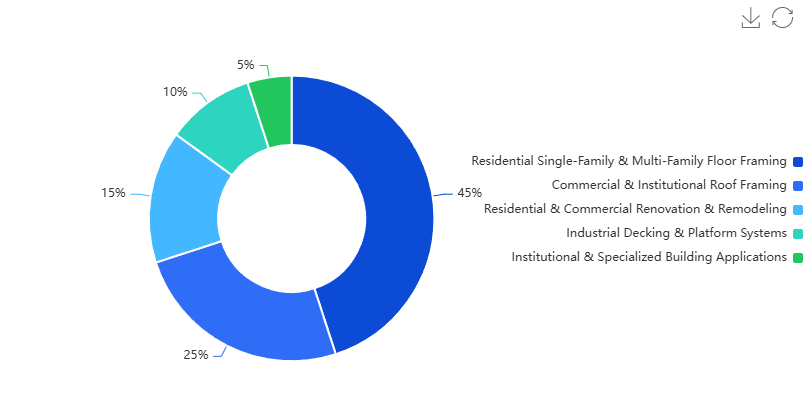
Residential Single-Family & Multi-Family Floor Framing (estimated share: 45%)
This segment is the core volume driver for Wood I-Joists, primarily used in floor systems for detached homes, townhouses, and low- to mid-rise apartment buildings. Current demand is fueled by the need for long, clear spans in open-plan designs, superior stiffness to reduce floor vibration, and efficiency in material use. Through 2035, demand will be shaped by the global housing shortage, particularly in urban areas favoring multi-family solutions. Key demand-side indicators include housing starts, average single-family home size, and the adoption rate of advanced framing techniques. The shift towards more stringent energy codes (like IECC) will further benefit I-joists, as their design allows for deeper insulation cavities compared to traditional joists. The mechanism is direct: each new housing unit or apartment building represents a quantifiable volume of floor area, a significant portion of which will utilize engineered floor systems for performance and code compliance. Current trend: Strong Growth.
Major trends: Accelerated adoption in multi-family construction for fire-rated floor-ceiling assemblies, Integration with prefabricated floor panel systems to reduce on-site labor, Growing use in combination with continuous insulation to meet passive house standards, and Product innovations for easier installation of mechanical, electrical, and plumbing (MEP) systems.
Representative participants: Boise Cascade, LP Building Solutions, Weyerhaeuser, Georgia-Pacific, and MiTek Industries.
Commercial & Institutional Roof Framing (estimated share: 25%)
Wood I-Joists are employed in roof framing for low-rise commercial buildings such as retail stores, schools, warehouses, and light industrial facilities. The current demand is driven by the product’s light weight, which reduces structural load and cost, and its ability to create long spans over open spaces. Looking to 2035, growth will be supported by the construction of logistics and distribution centers, big-box retail, and educational facilities. Demand-side indicators to watch include non-residential construction spending, warehouse construction starts, and investment in school infrastructure. The demand mechanism is linked to the roof area of these structures. As building owners and designers seek cost-effective, sustainable roofing solutions, wood I-joists compete directly with steel joists and trusses. Their advantage lies in faster installation in certain conditions, inherent thermal break properties, and a lower carbon footprint, which is increasingly factored into project specifications for institutional and corporate clients. Current trend: Moderate Growth.
Major trends: Use in hybrid roof systems combining I-joists with glulam beams for larger clear spans, Demand for pre-manufactured roof cassettes to speed up enclosure of building shells, Increasing specification in sustainable building projects targeting LEED or similar certifications, and Development of proprietary connection systems for improved wind uplift resistance.
Representative participants: Boise Cascade, Roseburg Forest Products, Metsä Wood, Alpine Engineered Products, and Huber Engineered Woods.
Residential & Commercial Renovation & Remodeling (estimated share: 15%)
This segment involves the use of I-joists in retrofit applications, such as replacing failing solid lumber floors, opening up interior spaces in existing homes, or adding new floors to commercial buildings. Current demand is resilient, often counter-cyclical to new construction, and driven by homeowner investment in improving living spaces and building functionality. Through 2035, demand will be sustained by the aging housing stock in North America and Europe, where structural upgrades are needed. Key indicators include remodeling expenditure indices, home improvement loan volumes, and the average age of the housing stock. The demand mechanism is project-based. Each renovation project that involves floor replacement or modification presents an opportunity to specify I-joists for their straightness, stiffness, and ability to span over removed load-bearing walls. This segment is less sensitive to interest rates for new mortgages and more tied to household equity and discretionary spending on home improvement. Current trend: Steady Growth.
Major trends: Growing DIY/Professional market for floor leveling and stiffening products, Use in attic conversions and basement finishing to create new living spaces, Retrofit solutions for strengthening floors to support modern appliance loads, and Partnerships with contractors and distributors specializing in renovation materials.
Representative participants: LP Building Solutions, Georgia-Pacific, PFS Corporation, and Local building material distributors.
Industrial Decking & Platform Systems (estimated share: 10%)
Wood I-Joists are used as a structural substrate for heavy-duty decking in industrial settings, such as mezzanine floors, material handling platforms, and stage/event flooring. Current demand is niche but stable, valued for the product’s high strength and predictable load ratings. The forecast to 2035 expects moderate growth tied to warehouse and industrial facility fit-outs, as e-commerce drives demand for efficient storage and material handling systems. Key demand indicators include industrial construction activity, capital expenditure in logistics, and manufacturing output. The demand mechanism is tied to the square footage of new mezzanine and platform construction within industrial buildings. Engineers specify I-joists for these applications due to their certified load tables, ease of integration with plywood or steel decking, and lighter weight compared to steel alternatives, which can simplify installation and reduce the load on the primary building structure. Current trend: Niche Growth.
Major trends: Specification in automated storage and retrieval system (AS/RS) support structures, Use in modular, relocatable industrial platform systems, Demand for fire-retardant treated (FRT) I-joists for certain industrial applications, and Integration with composite metal decking for specific load requirements.
Representative participants: Boise Cascade, Weyerhaeuser, and Specialized industrial component fabricators.
Institutional & Specialized Building Applications (estimated share: 5%)
This segment encompasses use in buildings like community centers, religious structures, recreational facilities, and other specialized projects where architectural design or specific performance requirements favor wood I-joists. Current demand is driven by the aesthetic desire for exposed wood structure, long spans in public gathering spaces, and the material’s sustainability narrative. Through 2035, demand will be supported by public infrastructure spending and the design community’s growing preference for biophilic and mass timber-inspired designs, even in hybrid applications. Key indicators are public construction spending and trends in architectural design specifications. The demand mechanism is project-specific and architect-driven. For certain institutional projects, designers select wood I-joists for a combination of performance, cost, and sustainability reasons, often using them in conjunction with other engineered wood products like glulam beams to create visually appealing, long-span roof structures that align with green building goals. Current trend: Stable.
Major trends: Use in hybrid mass timber projects as secondary framing elements, Specification in projects targeting Net Zero Energy or Living Building Challenge certification, Demand for custom lengths and depths for unique architectural designs, and Growing use in prefabricated roof systems for school and community building projects.
Representative participants: Metsä Wood, Katerra, Specialized engineered wood distributors, and Architectural millwork firms.
Key Market Participants
Interactive table based on the Store Companies dataset for this report.
| # | Company | Headquarters | Focus | Scale | Note |
|---|---|---|---|---|---|
| 1 | Weyerhaeuser | Seattle, Washington, USA | Wood products, lumber, I-joists | Global | Major integrated forest products company |
| 2 | Boise Cascade | Boise, Idaho, USA | Engineered wood products, I-joists | North America | Leading manufacturer and distributor |
| 3 | LP Building Solutions | Nashville, Tennessee, USA | Engineered wood products, I-joists | North America | Known for LP SolidStart I-joists |
| 4 | Roseburg Forest Products | Springfield, Oregon, USA | Engineered wood, I-joists, panels | North America | Manufactures ForceField engineered I-joists |
| 5 | Georgia-Pacific | Atlanta, Georgia, USA | Wood products, building materials | Global | Part of Koch Industries; produces I-joists |
| 6 | Mitek Industries | Chesterfield, Missouri, USA | Engineered wood connectors, software | Global | Key supplier of connectors for I-joist systems |
| 7 | iLevel by Weyerhaeuser | Seattle, Washington, USA | Engineered lumber, I-joists | North America | Weyerhaeuser’s engineered wood brand |
| 8 | Anthony Forest Products | El Dorado, Arkansas, USA | Engineered wood products, I-joists | North America | Manufacturer of I-joists and glulam |
| 9 | Allied Custom Products | Broken Bow, Oklahoma, USA | Engineered wood I-joists | Regional (US) | Manufacturer of ACP I-joists |
| 10 | Pacific Woodtech | Surrey, British Columbia, Canada | Engineered wood products, I-joists | North America | Canadian manufacturer |
| 11 | Huber Engineered Woods | Charlotte, North Carolina, USA | OSB, ZIP System, I-joists | North America | Produces AdvanTech I-joists |
| 12 | Mendocino Forest Products | Ukiah, California, USA | Redwood, engineered wood | Regional (US) | Manufactures I-joists and other products |
| 13 | Stark Truss | Canton, Ohio, USA | Roof and floor trusses, I-joists | Regional (US) | Major component manufacturer/distributor |
| 14 | Builders FirstSource | Dallas, Texas, USA | Building products supplier | National (US) | Major distributor of I-joists |
| 15 | 84 Lumber | Eighty Four, Pennsylvania, USA | Building materials supplier | National (US) | Key retailer/distributor of I-joists |
| 16 | Canfor | Vancouver, British Columbia, Canada | Lumber, pulp, paper | Global | Major Canadian forest products company |
Regional Dynamics
North America (estimated share: 55%)
North America remains the dominant and most mature market, characterized by high product acceptance, established building codes, and a concentrated manufacturing base. Growth will be steady, driven primarily by residential renovation, multi-family housing, and commercial roof systems. Market evolution will focus on product innovation for prefabrication and value-added services rather than pure volume expansion. Direction: Mature Growth.
Europe (estimated share: 20%)
The European market shows fragmented adoption, with strong penetration in Nordic countries and growing acceptance in Central Europe. Growth is underpinned by stringent energy performance regulations (EPBD) and the rise of prefabricated timber construction. Challenges include competition from solid timber and varying national building traditions, but the long-term trend favors engineered efficiency. Direction: Moderate Growth.
Asia-Pacific (estimated share: 15%)
Asia-Pacific represents the highest growth potential, led by urbanization in China, Southeast Asia, and Australasia. Demand is emerging in multi-family residential and commercial construction as builders seek faster, more efficient methods. Adoption is currently limited by familiarity and code integration but is expected to accelerate significantly post-2026 as local production and technical support networks develop. Direction: High Growth.
Latin America (estimated share: 6%)
A nascent market with growth concentrated in specific segments like high-end residential and commercial projects in major urban centers of Brazil, Mexico, and Chile. Adoption is constrained by cost sensitivity and a strong tradition of concrete construction. Growth will be incremental, tied to educational efforts by multinational suppliers and the development of local distribution channels. Direction: Emerging Growth.
Middle East & Africa (estimated share: 4%)
Very limited market currently, with minimal local production and use confined to specific expatriate housing compounds, hospitality projects, or facilities for international firms. Dominant concrete and steel construction cultures, along with climatic considerations, present significant barriers. Any growth will be niche and project-specific, often driven by international design standards. Direction: Limited Growth.
Market Outlook (2026-2035)
In the baseline scenario, IndexBox estimates a 4.2% compound annual growth rate for the global wood i-joists market over 2026-2035, bringing the market index to roughly 150 by 2035 (2025=100).
Note: indexed curves are used to compare medium-term scenario trajectories when full absolute volumes are not publicly disclosed.
This report provides an in-depth analysis of the Wood I-Joists market in the World, including market size, structure, key trends, and forecast. The study highlights demand drivers, supply constraints, and competitive dynamics across the value chain.
The analysis is designed for manufacturers, distributors, investors, and advisors who require a consistent, data-driven view of market dynamics and a transparent analytical definition of the product scope.
If you are the copyright owner and wish to request removal, please contact: info@woodworkersnews.com.