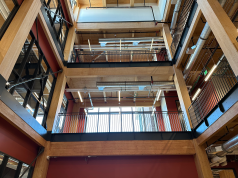

Traditionally, fire-rated interior applications in commercial settings have relied heavily on metal, mineral-based boards, or other non-combustible materials. Wood products, while widely used for structural and architectural applications, have often been excluded from certain building projects due to concerns about flame spread and smoke development. However, advances in fire-retardant treatment technology and testing standards are prompting a reassessment of how engineered wood can perform in regulated environments.
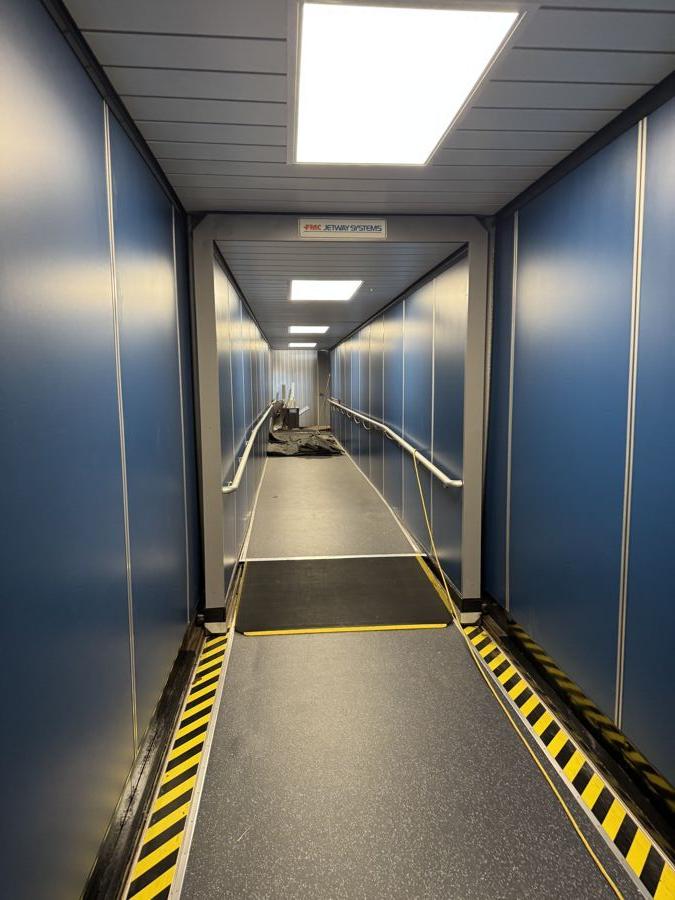
A recent illustration of this shift is evident in the United Airlines’ multi-location jetway renovation program. Jet bridges represent a unique subset of commercial infrastructure: enclosed transitional spaces exposed to continuous passenger flow, temperature fluctuations, and regulatory oversight. Materials used in these areas must withstand constant wear while complying with recognized fire-performance standards. For this renovation, the construction team needed panels that met ASTM E84 Class A requirements for flame spread and smoke development, while supporting efficient fabrication and installation across multiple project locations.
Instead of defaulting exclusively to traditional cladding materials, the project incorporated Garnica’s Fireshield plywood panels. Unlike traditional fire-retardant coatings, Fireshield veneers are engineered to preserve fire-retardant properties even after machining, making it a unique solution in the treated plywood category.
Engineered for interior applications, the plywood slows carbonization and resists flame spread, meeting top certifications, including ASTM E-84 Class A and CAN/ULC S102-10. The panels are also produced using FSC and PEFC-certified wood from European tree farms.
The adoption of fire-retardant plywood in a high-traffic aviation environment signals a broader evolution in commercial design thinking. Increasingly, specifiers are evaluating materials based on certified test data rather than traditional assumptions about combustibility. Fire testing standards such as ASTM E84 measure flame spread and smoke development under controlled conditions, providing quantifiable benchmarks that allow specifiers to compare materials objectively. When engineered wood products meet these benchmarks, they can be considered alongside more conventional options within appropriate assemblies.
Beyond fire performance, other factors are contributing to plywood’s expanded role in commercial interiors. Engineered plywood offers a high strength-to-weight ratio, making it easier to handle and install, particularly in renovation projects where minimizing structural load is important. Its machinability allows for precise fabrication, which can streamline installation timelines in multi-site programs. In retrofit environments such as airports, where construction often occurs in phases to avoid operational disruption, efficiency and predictability are critical.
Sustainability considerations are also influencing material selection. Many public agencies and private operators have adopted environmental performance goals, including reductions in carbon emissions and improved lifecycle efficiency. Responsibly sourced wood products can contribute to these objectives when used appropriately and in compliance with performance standards.
It is important to note that fire-resistant plywood does not eliminate the need for holistic fire-safety design. Material selection is only one component of a comprehensive strategy that includes compartmentalization, detection systems, suppression technologies, and evacuation planning. However, the integration of fire-retardant engineered wood into commercial assemblies demonstrates that safety and material versatility are no longer mutually exclusive.
As treatment processes become more sophisticated and testing protocols more rigorous, plywood is increasingly viewed not simply as a structural or decorative material, but as a high-performance component capable of meeting demanding regulatory requirements. For architects, engineers, and specifiers, the question is shifting from whether wood can meet fire standards to how it can be integrated effectively within compliant assemblies. Projects like United Airlines’ suggest that the conversation around fire-rated materials is evolving, informed by data, testing, and advancements in engineering rather than by longstanding assumptions.
As commercial infrastructure continues to be modernized across transportation, healthcare, education, and civic sectors, the range of materials available to designers is expanding. Fire-resistant plywood is not replacing other materials outright, but it is earning a place among them, offering another viable option in environments where safety, durability, and performance remain paramount.
In addition to meeting strict performance requirements, engineered plywood offers designers a level of architectural flexibility that more conventional materials often lack. Its workability allows panels to be fabricated into a wide range of interior elements, from wall systems to integrated architectural details, while maintaining a consistent and natural material character. For architects and designers, this versatility makes it possible to address performance, durability, and code requirements while maintaining the warmth and visual continuity that wood brings to commercial and public spaces.