
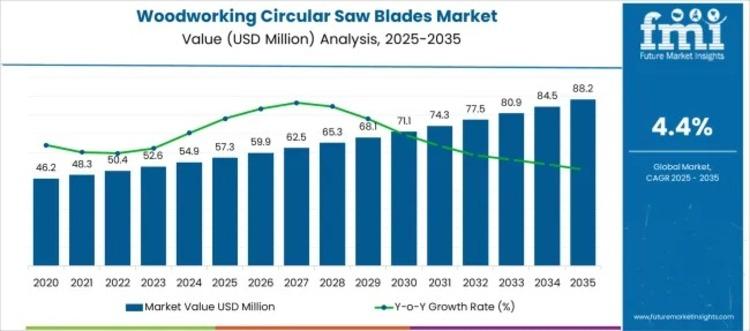
The demand for woodworking circular saw blades market is gaining momentum as construction, furniture manufacturing, and DIY activities expand worldwide. Market expenditure is estimated at USD 57.3 million in 2025 and is projected to reach USD 88.2 million by 2035, expanding at a CAGR of 4.4%. This growth underscores the essential role of high-performance saw blades in supporting precise, safe, and efficient woodworking operations across industrial, commercial, and residential segments.
Key Market Indicators
– Market value (2025): USD 57.3 million
– Forecast value (2035): USD 88.2 million
– Forecast CAGR (2025-2035): 4.4%
– Dominant blade type: Framing blade
– Leading mode of operation: Stationary machine
Industrialization and Construction Activity Sustain Core Demand
Global construction activity, infrastructure development, and industrialization are primary drivers for saw blade demand. Urbanization and rising consumer spending in residential and commercial projects have boosted the adoption of framing, rip-cut, and crosscut blades.
Industrial demand drivers include:
– Increased construction and renovation projects worldwide
– Adoption of automation and stationary woodworking machines
– Emphasis on precision, efficiency, and reduced downtime
Furniture Manufacturing and DIY Trends Enhance Market Growth
Growing demand for premium furniture, cabinetry, and woodcraft, coupled with the expansion of DIY home improvement projects, is increasing consumption of durable and versatile circular saw blades.
Key factors driving adoption:
– Framing blades favored for rough and structural cuts
– 100-200 mm blade diameter range preferred for versatility
– Stationary machines adopted in professional workshops for higher throughput
Technological Advancements Improve Blade Efficiency
Innovations in blade materials and design are enhancing cutting performance and durability. The rise of carbide and diamond-coated blades offers higher abrasion resistance and longer tool life, supporting industrial and residential woodworking needs.
Technology trends shaping the market:
– Advanced coatings for longer lifespan and sharper cuts
– Optimization of blade design for medium and fine cuts
– Integration with automated woodworking systems
Regional Dynamics Highlight Strategic Opportunities
Market growth varies across geographies due to construction, industrialization, and furniture production trends.
Regional highlights:
– North America: Increased commercial & residential construction; 23.7% market share in 2025
– Europe: Renovation and new builds drive demand; 28.3% market share
– Asia-Pacific: Rapid urbanization, furniture demand, and industrialization support growth
Competitive Landscape Balances Global and Local Strengths
Global leaders like Robert Bosch GmbH, Stanley Black & Decker, DEWALT, HiKOKI, and Homag Group dominate with advanced, high-performance portfolios. Domestic and regional players leverage local regulatory knowledge, faster delivery, and competitive pricing to strengthen market position.
Competitive strategies include:
– Investment in R&D and blade innovation
– Expansion of online and offline sales channels
– Introduction of specialized blades for framing, finishing, and metal cutting
Outlook: Steady Growth Anchored in Industrial and Construction Demand
The woodworking circular saw blades market is expected to grow steadily through 2035. Framing blades, stationary machine operations, and the 100-200 mm diameter segment will remain key contributors. Rising construction projects, urbanization, and furniture manufacturing will collectively sustain market demand.
If you are the copyright owner and wish to request removal, please contact: info@woodworkersnews.com.