
Our evidence is conclusive: we know that Drax has produced wood pellets made from old growth trees.
For the past 25 years, Stand.earth has been a watchdog for old growth forests. Alongside First Nations, community groups, and climate scientists, we advocate to protect what remains of rare, at-risk forests in B.C. At Stand.earth, we know that old growth trees are essential elements of biodiverse ecosystems – places that are teeming with life, and which provide one of the best defences against the impacts of human-caused climate change, especially worsening wildfires, droughts, and flooding.
Today, we see policy failures and broken political promises that have pushed these ecosystems to the brink and allowed big corporations – from foreign-owned logging companies to wood pellet exporters – to extract as much as they can for profit, under the guise of forest “management.” The aftermath is obvious – sprawling clearcuts where old growth forests once stood, replaced with dense plantations that catch fire like matchsticks. And now, with our latest investigation into the forest biomass export industry, we see what some might prefer remain hidden – old growth logs purchased by Drax.
British Columbia is far from a global leader in “forest management.” The province has failed to properly implement its old growth deferrals framework, leaving some of the most ecologically important forests open to logging – and to biomass sourcing. There is no sustainable way to industrially log old growth forests.
In order to understand the forest biomass export industry’s contribution to forest degradation in B.C., we need to consider the state of old growth protection in the province. The vast majority of productive old growth forests have already been logged, generally with only fragments remaining. While the provincial government has designated (or claims to have designated) some areas as off-limits to logging – like old growth deferral areas – some of the most at-risk old growth forests are conspicuously absent from protection. And while the B.C. government had officially recognized the need to protect remaining old growth forests, it has seemingly abandoned its past promises even though environmental experts and the Union of B.C. Indian Chiefs have repeatedly highlighted the importance of protecting old growth.
Claims that B.C. is a world leader in sustainable forest management, which the wood pellet export industry often cites to justify its sourcing practices, are not only misleading but also serve to further entrench the most harmful types of logging. Instead of “managing” forests, this moment calls for a complete paradigm shift. The province must move away from an approach that puts timber extraction above all else to one that focuses on regenerative practices and keeping old forests standing. That is why our investigation into Drax’s sourcing looked in particular at its sourcing in a region where our own research has previously indicated a disproportionate amount of old growth logging occurs, compared to the rest of B.C.
Drax has purchased whole logs cut from old growth stands. And, with a near monopoly on the wood pellet export industry in B.C., Drax is a company that benefits from business-as-usual clearcutting in the province. Publicly available data showed some high-grade logs arriving at Drax’s facilities.
Old growth trees are most valuable for ecosystems when they are left alive and standing. And even when trees have fallen on the forest floor, they contribute to biodiversity by enriching soil, providing shelter for animals, feeding insects, and serving as nurse logs for new trees. But B.C. puts worth on trees based on their use to conventional milling, assigning grades that do not necessarily reflect a tree’s age or broader value. This system means that old growth trees can be labelled as poor quality or waste, despite their importance to forest ecosystems.
Drax has claimed to be making use of wood waste that other companies reject. It’s worth noting that if a company like Drax purchases logs that were rejected by other potential customers, this does not mean those trees had no ecological value before they were cut down.
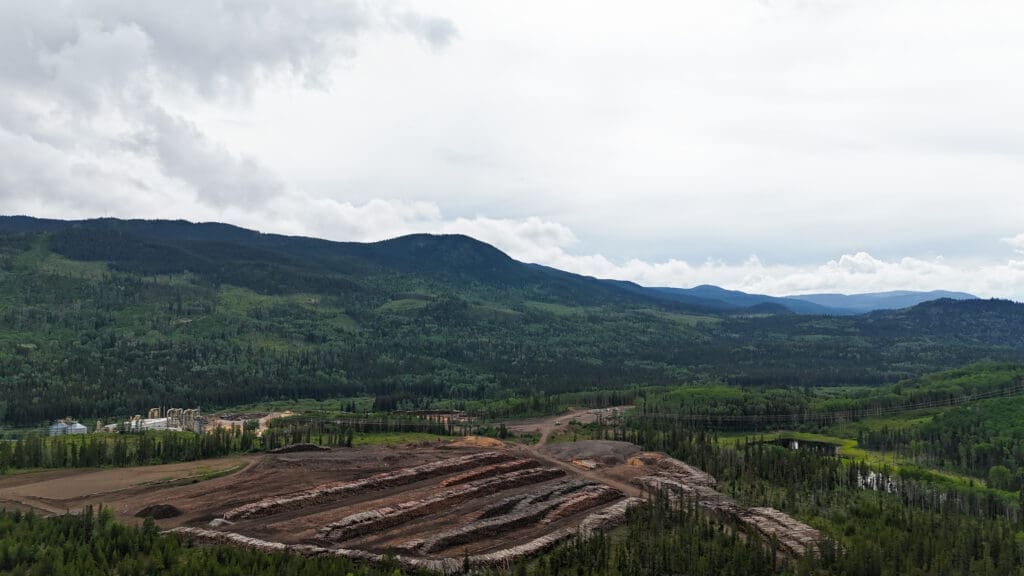
Using a robust methodology with a focus on data integrity and authoritative sources, our investigation leveraged much more than timber mark-level information. The pieces of this puzzle are in the public domain, if you know where to look.
How did our investigation determine with certainty that Drax has purchased whole logs from regions overlapping with old growth? Our research team used publicly available data, including provincial mapping, and timber marks from invoices that are produced when a truckload of logged trees is weighed at a pellet plant.
Then with Geographic Information System (GIS) analysis using satellite imagery, we confirmed areas that were logged within timber marks of interest. One of the tools in our toolbelt is Forest Eye, our satellite monitoring system – with recent logging alerts available for anyone to consult. From regularly updated satellite imagery, we can determine when specific old growth cutblocks were logged by companies like West Fraser, Canfor and more.
Combining information from invoices and satellite imagery let us put together the pieces on this investigation. Researchers determined when a cutblock within a given timber mark was logged, whether or not those areas were old growth, and when Drax received shipments of logs at its pellet plants from those areas. Using this combination of datasets, we could confirm areas where Drax definitively sourced old growth, as well as areas where Drax likely sourced old growth.
Using this process also led researchers to other alarming findings. We know that in 2024, Drax received 219 truckloads of logs from a set of cutblocks that overlapped with moose habitat. Using satellite imagery, we determined that the area was logged in June 2024, during a window where Drax was the majority customer of logs from this site. Based on the timing and proportions, our data strongly suggests that logs from this wildlife-sensitive area were delivered to Drax. This sourcing is indicative of a bigger issue in the province: B.C. has no standalone biodiversity legislation or legislation protecting species, and logging continues to move forward even in areas that are vital wildlife habitats.
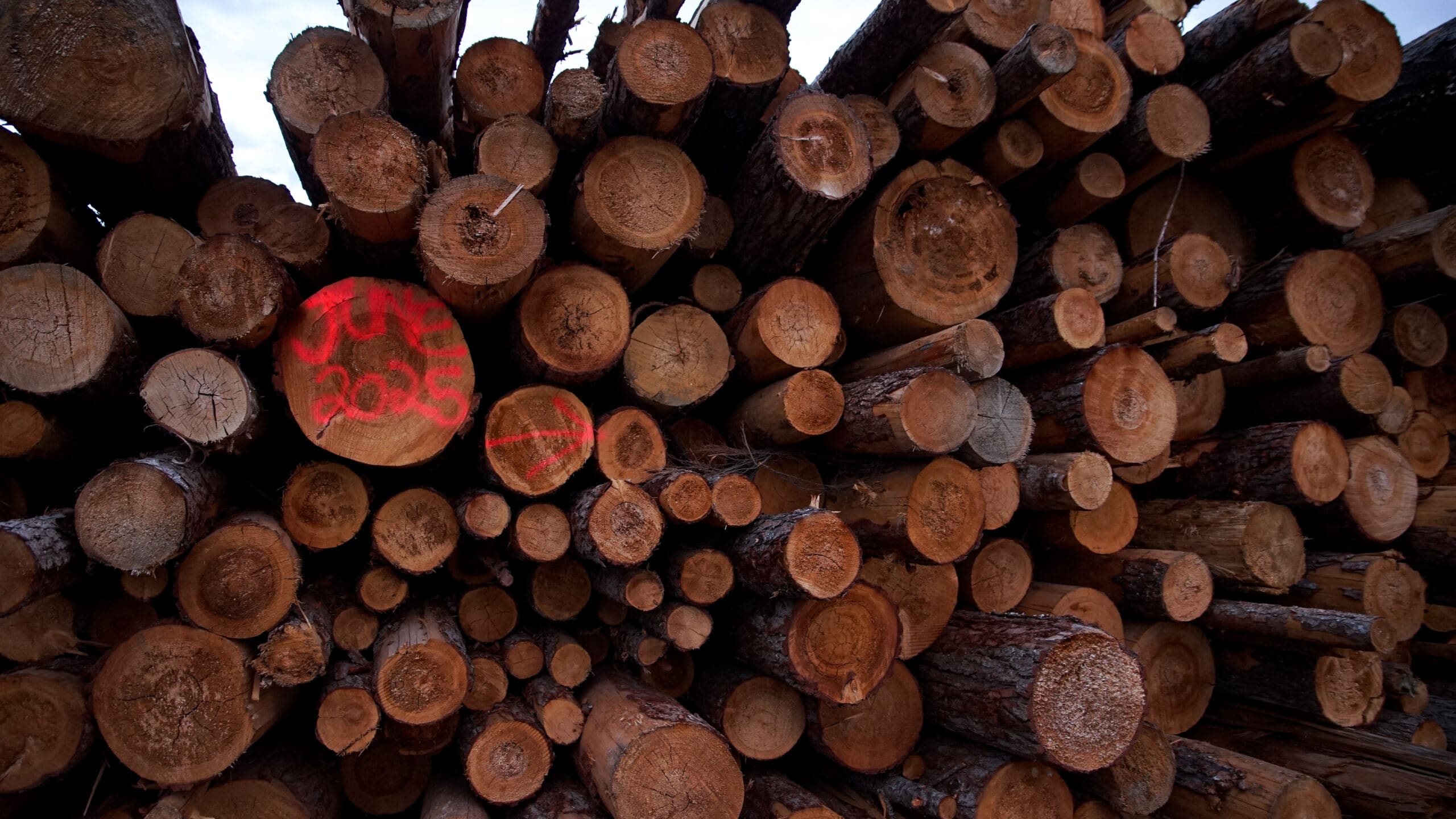
We didn’t just rely on our eye in the sky to expose Drax’s operations. We also visited some of the sprawling clearcuts from which Drax had likely sourced whole logs, and stopped by the company’s biggest pellet plant in B.C. just outside of Burns Lake. In its log yard, we counted rings on freshly-cut, large trees and confirmed, yet again, Drax’s sourcing of old growth.
Drax’s wood pellet plants are in regions that have already been devastated by resource extraction – this includes not only clearcut logging, but mining activities and the construction of fossil fuel pipelines as well. This history of industrial activity has created the very conditions that lead to the catastrophic megafires that increasingly threaten communities in these regions.
One such region is the territory of Stellat’en First Nation. While conducting fieldwork for our investigation into Drax’s sourcing practices, we spent time with Janelle Lapointe on her lands, Stellat’en territory. We stood with Janelle in the middle of vast clearcuts and walked along the snaking network of roads that were built to serve industry. We struggled trying to find any remaining old forest stands among these scars left on the landscape.
In a recent piece in the Walrus, Janelle highlighted an alternative vision for her community and others who have faced years of industrial extraction:
“Far too often, people hear about economic development and think of industry, factories, big companies, and assimilation into the Canadian extraction economy. Another way forward exists. Across this land, nations are bringing local food systems back to life through hunting, fishing, farming, and careful preservation that feed people and nurture the soil. Indigenous communities are now backing renewable energy projects that cut diesel reliance, keep energy ownership local, and let revenue stay within the community.”
Old growth forests are a vital part of communities’ long-term resilience. As we work to defend these ecosystems across B.C., there should be no question that whole trees and old growth must be off-limits to sourcing for wood pellets. Several countries provide massive “green” subsidies to forest biomass companies. This includes the United Kingdom, which provides billions in taxpayer money to Drax. Any government that props up this sector cannot afford to look the other way when confronted with clear evidence that runs counter to the industry’s sustainability claims.
For our part, we continue the work of bearing witness on the ground and in the sky, in solidarity with impacted communities.
If you are the copyright owner and wish to request removal, please contact: info@woodworkersnews.com.