
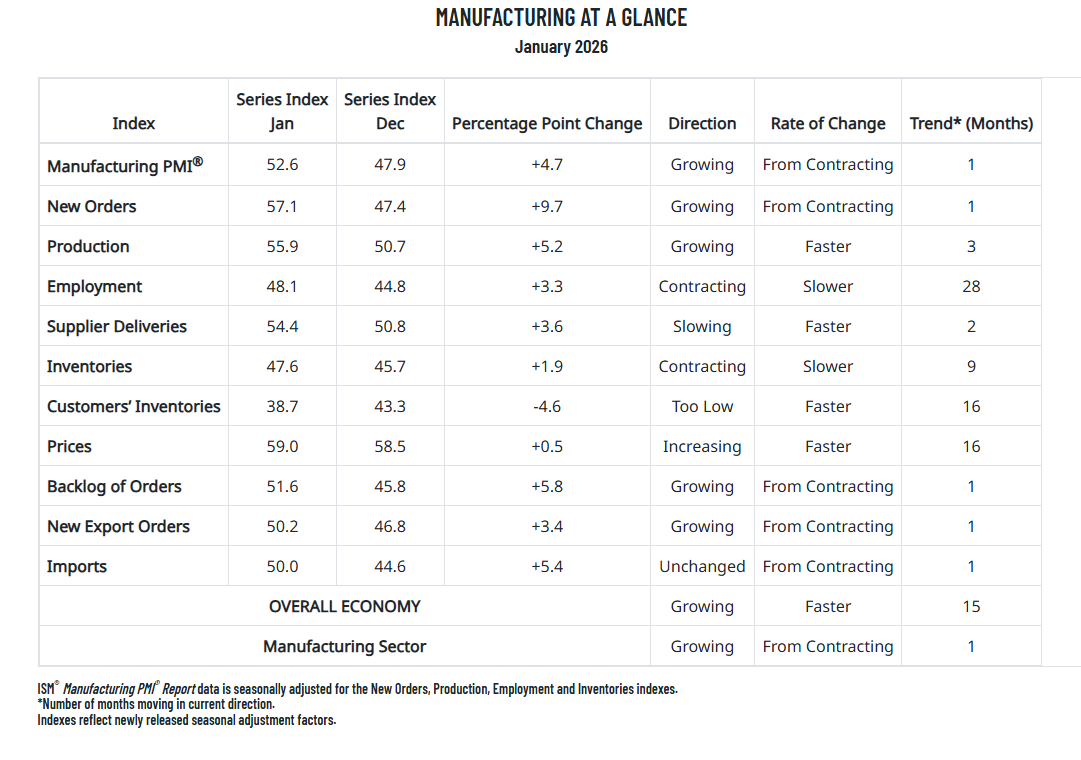
TEMPE, Ariz. — Economic activity in the manufacturing sector expanded in January for the first time in 12 months, preceded by 26 straight months of contraction, say the nation’s supply executives in the latest ISM Manufacturing PMI Report.
The report was issued by Susan Spence, MBA, chair of the Institute for Supply Management Manufacturing Business Survey Committee.
“The Manufacturing PMI registered 52.6 percent in January, a 4.7-percentage point increase compared to the seasonally adjusted reading of 47.9 percent in December. The overall economy continued in expansion for the 15th month. (A Manufacturing PMI above 47.5 percent, over a period of time, generally indicates an expansion of the overall economy.) The New Orders Index expanded for the first time since August, with a reading of 57.1 percent, up 9.7 percentage points over December’s seasonally adjusted figure of 47.4 percent and its highest since February 2022 (59.7 percent). The January reading of the Production Index (55.9 percent) is 5.2 percentage points higher than December’s seasonally adjusted figure of 50.7 percent and the highest since it reached 58.1 percent in February 2022. The Prices Index remained in expansion (or ‘increasing’ territory), registering 59 percent, 0.5 percentage point higher than December’s reading of 58.5 percent. The Backlog of Orders Index registered 51.6 percent, up 5.8 percentage points compared to the 45.8 percent recorded in December and the highest reading since August 2022 (53 percent). The Employment Index registered 48.1 percent, up 3.3 percentage points from December’s seasonally adjusted figure of 44.8 percent.”
“Although our volume is low at the moment, the impact on the latest tariff threats on the European Union will have a huge negative impact on our profit for current quoted orders. We will not be able to recover the increase tariffs in our current quotations,” notes a machinery manufacturing respondent of the data. Other respondents of the data note impending tariffs will create more uncertainty across all manufacturing sectors.
“Looking at the manufacturing economy, 20 percent of the sector’s gross domestic product (GDP) contracted in January, compared to 85 percent in December, and the percentage of manufacturing GDP in strong contraction (defined as a composite PMI of 45 percent or lower) decreased to 12 percent, compared to 43 percent in December. The share of sector GDP with a PMI at or below 45 percent is a good metric to gauge overall manufacturing weakness. Of the six largest manufacturing industries, five (Transportation Equipment; Machinery; Chemical Products; Food, Beverage & Tobacco Products; and Computer & Electronic Products) expanded in January,” says Spence.
The nine manufacturing industries reporting growth in January — listed in order — are: Printing & Related Support Activities; Apparel, Leather & Allied Products; Fabricated Metal Products; Primary Metals; Transportation Equipment; Machinery; Chemical Products; Food, Beverage & Tobacco Products; and Computer & Electronic Products. The eight industries reporting contraction in January — in the following order — are: Textile Mills; Wood Products; Nonmetallic Mineral Products; Electrical Equipment, Appliances & Components; Petroleum & Coal Products; Plastics & Rubber Products; Furniture & Related Products; and Miscellaneous Manufacturing.
Wood and furniture & related products note a decrease in production, inventories, and customer customer inventories.
Wood manufacturing also decreased in new orders, employment, prices for raw materials, new export orders, and imports.