
From train interiors to long-span structural elements, Strong by Form is pushing wood far beyond its traditional performance limits. Rather than relying on material substitution alone, the company unlocks structural efficiency through geometry optimisation, fibre architecture and proprietary forming processes, enabling wood-based composites to enter performance domains typically reserved for mineral or synthetic materials.
In this interview, Andrés Mitnik, CEO of Strong by Form, details the technological foundations of the company’s approach, the progress achieved over the past year, from component-level innovation to full-scale structural prototypes and the remaining challenges on the road to certification, industrialisation and market adoption in mobility and construction.

JEC Composites: If you had to sum up Strong by Form in one sentence, what would be your key promise and what sets you apart most from other players in the low-carbon materials sector?
Andrés Mitnik: Strong by Form enables wood to structurally compete with concrete, steel, and aluminum at a competitive price and a fraction of the carbon footprint by controlling geometry and fibre orientation at an industrial scale, rather than relying on material substitution alone. What sets us apart is that we do not treat wood as a standard building product, but as an engineered composite whose performance is unlocked through shape optimisation, fibre architecture and manufacturing logic, allowing us to reach performance domains typically reserved for mineral or synthetic materials.
What are the technological building blocks that make you unique and what concrete advances have you made in the last 12–18 months? Can you give an example?
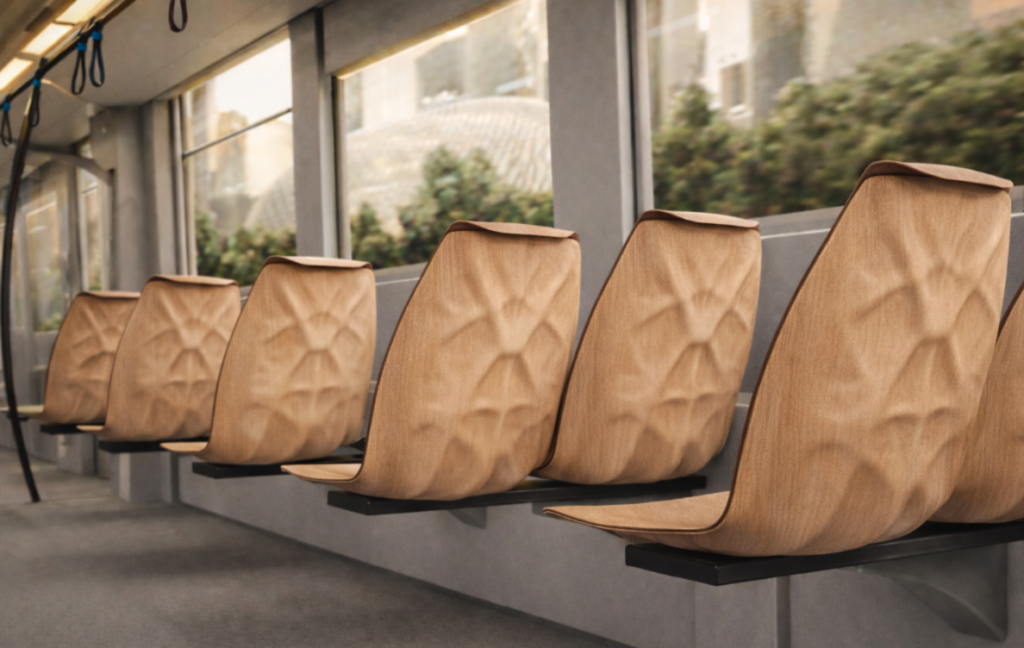
Our technology is built on four core pillars: computational design and structural optimisation, controlled fibre orientation in wood-based composites, proprietary forming and pressing systems, and digitally assisted manufacturing cells. The last 12 months have culminated in two concrete outcomes: the development of a structural train seat shell, designed to meet strict mechanical, fire, and weight requirements, and the fabrication of a 10-meter-long structural prototype, demonstrating scalability beyond typical timber or composite limits. Together, these projects mark our transition from component-scale innovation to full-scale structural systems.
What evidence can you share today and what barriers remain to be overcome for large-scale deployment?
Today, we can demonstrate mechanical test results validating load-bearing performance and stiffness at weights significantly below conventional solutions, repeatability through robotic manufacturing processes, and the feasibility of producing long-span elements with consistent quality. For the train seat application, we have advanced testing on structural behaviour, vibration, and durability, with fire and smoke performance currently being addressed as part of the railway certification pathway. The main remaining barriers to large-scale deployment are certification timelines, particularly for fire performance in transport and building applications and the capital investment required to industrialise long-span manufacturing systems at commercial volumes.

Which use cases are you focusing on as a priority ?
Our priority use cases today are rail mobility and structural construction systems. In mobility, we are focusing on train interiors as a first industrial product, as they combine high repetition, strict performance requirements, and a clear demand for lightweight, low-carbon alternatives. In construction, the 10-meter prototype represents a critical step toward structural slabs and long-span elements that can directly compete with reinforced concrete in performance and price.