
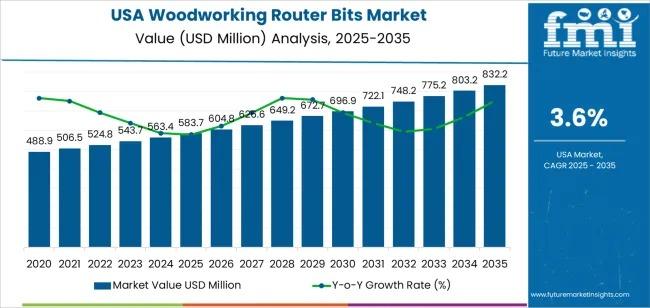
This sustained growth reflects rising activity across residential construction, renovation projects, furniture manufacturing, and the expanding DIY woodworking ecosystem. Router bits remain indispensable for shaping, trimming, grooving, and detailing wood, supporting both professional workshops and hobbyist users nationwide.
Key demand drivers include:
– Growth in residential renovation and remodeling activity
– Rising preference for custom cabinetry and furniture
– Continued commercial construction and interior fit-outs
Year-over-year market expansion reflects a gradual but reliable trajectory, with market value reaching approximately USD 672.7 million by 2029 before accelerating toward USD 832.2 million by 2035.
DIY Woodworking Expands the Consumer Base
Beyond professional applications, DIY woodworking has become a powerful growth contributor. Hobbyists and small workshops increasingly invest in routers and premium router bits to achieve professional-grade finishes.
This trend is supported by:
– Increased access to online tutorials and maker communities
– Growth of home-based woodworking and crafting projects
– Higher consumer willingness to invest in durable, precision tools
As a result, router bits are no longer viewed as disposable accessories but as long-term performance tools across user segments.
Carbide-Tipped Bits Lead Material Demand
Material innovation plays a defining role in purchasing decisions. Carbide-tipped router bits dominate the USA market, accounting for approximately 50% of total demand.
Material leadership is driven by:
– Longer tool life compared to high-speed steel alternatives
– Superior wear resistance on hardwoods and composites
– Cleaner cuts and reduced tool replacement frequency
Professionals and serious hobbyists increasingly favor carbide-tipped bits as productivity enhancers, particularly for repetitive or high-precision applications.
Straight Router Bits Maintain Market Leadership
By bit type, straight router bits account for nearly 40% of USA demand, reflecting their versatility and foundational role in woodworking.
Straight bits are widely used for:
– Grooving and dado cutting
– Edge trimming and joint preparation
– General-purpose shaping applications
Their cost-effectiveness and broad usability ensure continued dominance across professional, commercial, and DIY woodworking environments.
CNC Woodworking Accelerates Precision Demand
The adoption of CNC routing systems in small and mid-sized workshops is reshaping router bit demand. CNC machines require bits capable of delivering consistent accuracy over extended production runs.
This trend is driving demand for:
– High-precision, application-specific router bits
– Enhanced coatings for heat and wear resistance
– Bits optimized for automated and high-speed routing
As CNC penetration increases, premium router bits are gaining traction across furniture manufacturing and custom woodworking operations.
Regional Outlook Reflects Diverse Growth Patterns
Regional growth varies based on construction activity and woodworking culture:
– West: Leading growth at a CAGR of 4.2%, driven by renovation activity and custom woodworking
– South: CAGR of 3.7%, supported by residential construction and furniture manufacturing
– Northeast: Moderate growth at 3.3%, anchored in custom and commercial woodworking
– Midwest: CAGR of 2.9%, reflecting slower adoption of advanced tooling
These regional trends highlight the market’s balanced and geographically diversified demand base.
Competitive Landscape Focuses on Quality and Durability
Competition in the USA woodworking router bits market centers on tool longevity, cutting precision, and application versatility. Leading manufacturers include Amana Tool, Whiteside Machine Company, CMT Orange Tools, Bosch Tools, and Winsen Industry Co., Ltd.
Key competitive strategies include:
– Emphasis on carbide-tipped and coated bit technologies
– Offering task-specific bit sets for cabinetry and furniture
– Building brand trust among professional woodworkers
Quality, reliability, and performance consistency remain the primary differentiators in purchasing decisions.
Strategic Outlook