
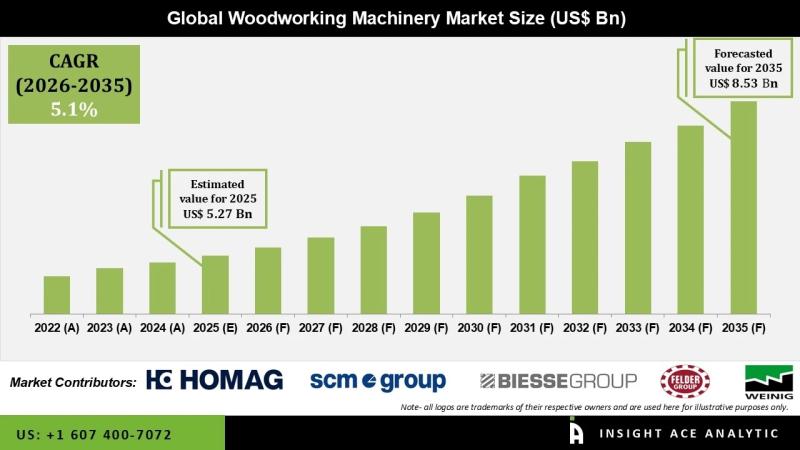
The woodworking machinery market has grown significantly in recent years as a result of the building and furniture sectors’ global expansion. Additionally, the increasing need for high-quality wood products brought on by urbanization and infrastructure development projects has increased demand for contemporary woodworking machinery. However, the high initial investment prices, the requirement for specialized people to run sophisticated gear, and maintenance costs are some of the market’s obstacles, which may put off small and medium-sized businesses.
List of Prominent Players in the Woodworking Machinery Market:
• HOMAG Group
• SCM Group
• Felder Group
• Holz-Her
• Paolino Bacci
• IMA Schelling Group
• Timesavers
• Leadermac (Cantek)
• Biesse Group
• Michael Weinig AG
• Nanxing Machinery
• Anderson Group
• Grizzly Industrial
• JET (JPW)
• Makita Corp.
• Laguna Tools
• SawStop
• Festool
• Powermatic (JPW)
• Shandong Baide
Market Dynamics:
Drivers:
The growing need for personalized furniture and interior design solutions in both the residential and commercial sectors is propelling the woodworking machinery market. Increasing automation and the use of CNC machines are increasing productivity and efficiency. The need for equipment is further increased by growing construction and remodeling trends. Technological developments in eco-friendly designs and precise cutting also increase the value of products and expand the woodworking machinery market. Additionally, there are a lot of prospects for woodworking equipment makers due to the growing trend toward smart production and Industry 4.0. Because of increased industrialization and the need for reasonably priced, high-quality furniture, emerging economies provide significant growth potential.
Challenges:
In the woodworking machinery market, high upfront expenditures are a major obstacle, especially for small and medium-sized businesses (SMEs) wishing to engage in cutting-edge technologies. The lack of qualified workers to run sophisticated gear has an impact on efficiency and production as well. The production output can be hampered by shifting raw material prices and supply chain interruptions. For market participants, operational complexity and expense demands are further increased by environmental rules and safety compliance requirements. Additionally, when used incorrectly, woodworking machinery used in production can be dangerous. Therefore, in all production facilities, health and safety cannot be disregarded. The health risks include exposure to unsecured machinery, wood dust, noise, toxic finishes, and non-ergonomic handling, all of which have a detrimental effect on workers’ health and raise severe concerns.
Regional Trends:
In 2025, the European region held the largest share in Woodworking Machinery market. Due to the region’s strict environmental and sustainable regulations, companies are making investments to cut waste in any way possible by acquiring cutting-edge technologies that enable them to do so while producing carbon-neutral solutions. Additionally, the modern CNC machines are being used more and more by European furniture producers to assure accuracy and efficiency while also meeting strict environmental requirements. Furthermore, due to the increasing use of engineered wood in high-end industries like interior design and construction, which require premium personalized wood products, the woodworking machinery market has grown significantly in Europe.
Over the forecast period, the Asia Pacific region is anticipated to grow at the fastest rate in the Woodworking Machinery market due to the expanding industrial sector, urbanization, and rising demand for furniture and building supplies in the area. China, India, and Japan dominate the market due to their growing woodworking and industrial infrastructure development. The use of CNC technology, which yields superior results at reduced costs, and automated saws and planers has significantly increased in the area. Additionally, g rowing interior design and building projects, as well as rising customer demand in customized wood goods, all contribute to the market’s expansion. The government encourages the use of innovative woodworking machinery through its programs for skill development, industry modernization, and environmentally friendly production methods.