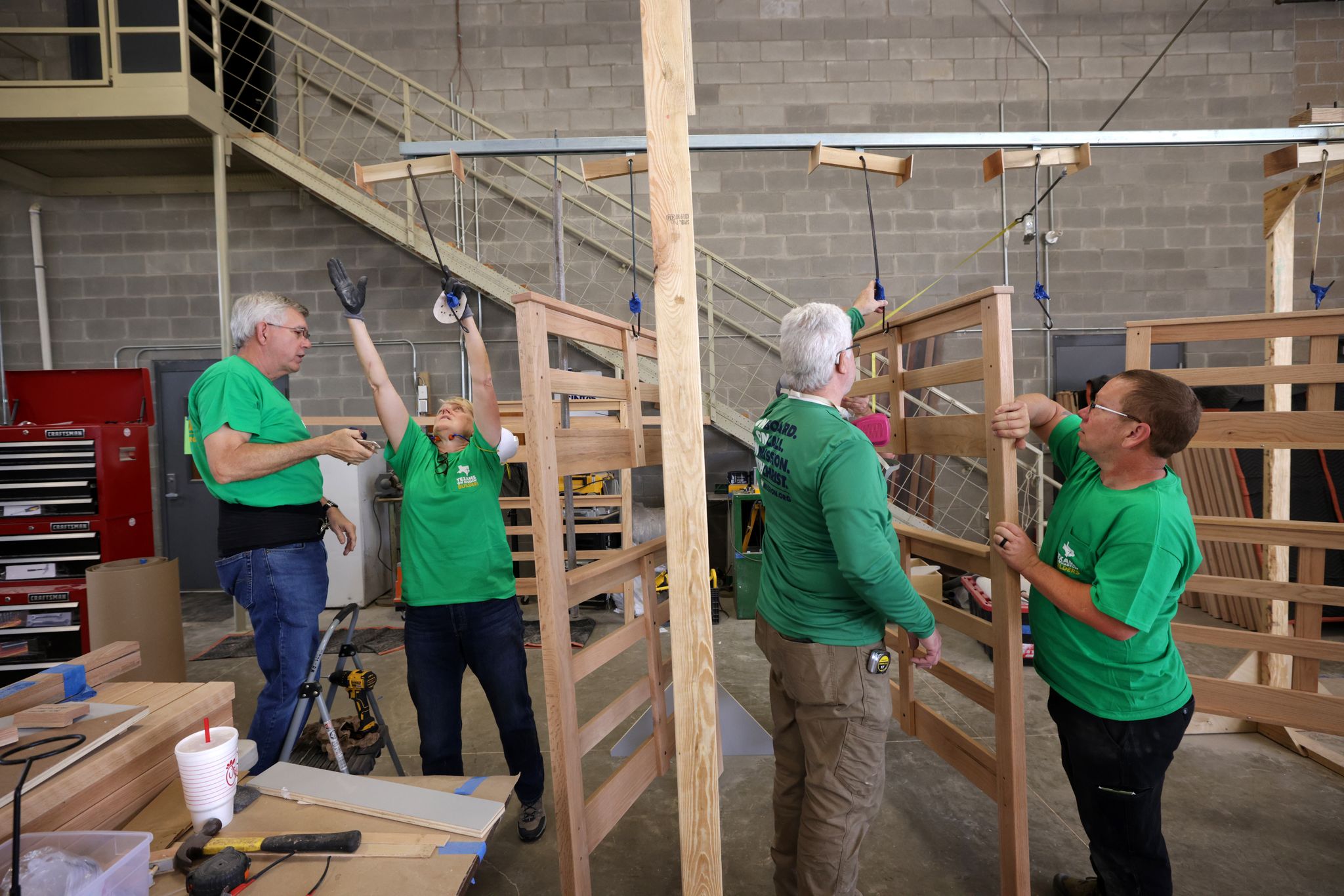
If you are Wayne Pritchard, you drive 40 minutes from your home in Kaufman County to a workshop in Dallas, even as your friends question why you are not watching movies at home or playing golf. You pick up a drill and a sturdy plank of pristine red oak wood. You build bunk beds, piece by painstaking piece, for young campers and the ones who will come after them.
“I’ve done a lot of fun things in my life, but nothing compares to this,†Pritchard said. “The feeling we get knowing we are doing God’s work is hard to describe.â€
Pritchard is 75 years old, a grandfather and woodworker. After retiring from the automotive industry a few years ago, he was looking for a way to stay busy and found Texans on Mission, a Christian disaster relief organization based in Dallas.
After the flood ravaged Hill Country last year, killing some 140 people, Pritchard deployed with other Dallas-area volunteers to Central Texas. The photographs and videos he saw beforehand did little to prepare him for the soggy homes with crumbling walls stained by mud and muck, the cars submerged in the river, the canoe tangled 30 feet high in a tree. Nothing made sense.
Texans on Mission returned again and again to Hill Country to build homes, paint cabins, lay sod and remove downed tree limbs.
When the organization learned Camp La Junta in the town of Hunt needed bunk beds, it offered to help. Typically, clients pay for the cost of materials, including lumber. In this case, Texans on Mission received enough donations to cover nearly the entire cost of 75 bunk beds. When Pritchard gave the camp the news, a staff member at La Junta began to cry. He told her she better stop because he might start crying.
“No one,†he told her, “needs to see my cry.â€
Camp La Junta plans to reopen in June, nearly one year after one of the deadliest floods in U.S. history. The camp has faced little, if any, pushback over reopening, in contrast to Camp Mystic, the all-girls camp where 27 girls and the camp’s executive director died in the floods. One girl, Cile Steward, has yet to be found, and parents have sued to keep the camp from reopening this summer.
Fifteen minutes up the river, Camp La Junta plans to host an open house in the coming weeks as it prepares to open.
About 300 miles away in Dallas, volunteers meet at the open-air workshop off Samuell Boulevard a few days each week and pray together. Like Pritchard, many volunteers are retired and looking to fill their days and do some good. Some have woodworking experience but others have never handled a drill. No experience is necessary, just a willingness to learn.
Each bed is built with nearly 50 pieces of wood, which must be measured, cut, sanded and treated so it does not break down in the humidity. At one point, a 250-pound volunteer tested out the top bunk. The frame barely budged.
Some volunteers have their own memories of camp. Tony Tarpley, who lives in Red Oak, began volunteering with Texans on Mission shortly after retiring in 2018 from Bell Helicopter as a mechanical engineer. He went to work in the group’s cabinet shop building furniture for churches devastated by tornadoes, a ministry for young Native Americans, a summer camp for physically handicapped children, and now, bunk beds for Camp La Junta.
As a boy, Tarpley attended a Christian camp in the New Mexico desert. He is now 68, but he still remembers how his faith sprouted and grew at the camp in the red rocks.
“I don’t think God designed us to just sit at home and be self-absorbed,†Tarpley said. “We’re building these beds to last not only this generation, but future generations of campers.â€
Billye Rhudy, 66, drove two hours from her home in Gatesville, a small town near Waco, to Dallas to build bunk beds this week. After the floods, she helped run a shower and laundry facility in the Hill Country, where residents could get a free shower while volunteers laundered their clothes.