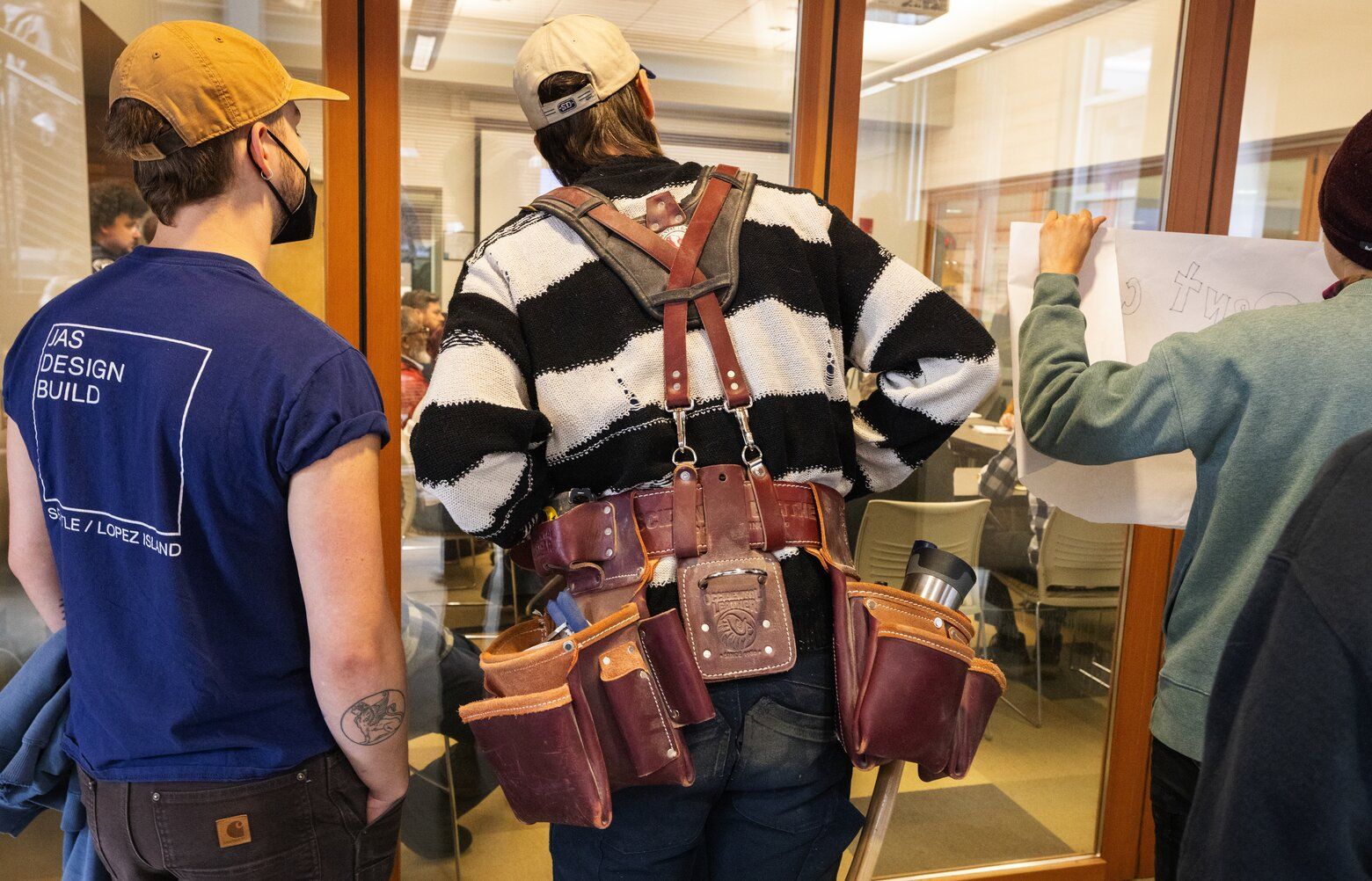
When the meeting ended, the students escorted administrators to the exit, chanting: “CUT WOOD, NOT EDUCATION!â€
The protest was sparked by a proposal to sell the Wood Technology Center building to help offset a budget deficit. It is the second time in three years that the program, a division of Seattle Central College with a bespoke building in the heart of Seattle’s Central District, has faced this situation.
But as of Monday afternoon, the details remain murky: how large the deficit is, whether the building will actually be sold, and what would happen to one of the region’s only comprehensive training programs for carpentry and boatbuilding.
“We are considering the sale of Seattle Colleges’ properties, including Seattle Central’s Wood Technology property, and relocating the programs, where applicable, to sister colleges,†Seattle Colleges spokesperson Barb Childs wrote in an email, emphasizing ongoing challenges due to state budget cuts and operating costs. “As we consider the sale of properties, we are seeking the most seamless and softest landing for our students.â€
Students say they learned about the proposal not from administrators, but through instructors and informal conversations in recent days.
“It’s pretty devastating with everything else going on, and everything in the economy. It’s just a huge lack of priority to the trades,†said Lizbeth Chaidez, a carpentry student and president of Wood Tech’s student council.
The information they have is pieced together. Faculty said they were told the college is considering selling the building and winding down programs after current students finish, a process that could begin as soon as this fall. But even that timeline appears uncertain, and administrators have not publicly confirmed specifics.
“It makes no sense to me,†said Catie Chaplan, lead carpentry instructor and the first woman to graduate from Wood Tech’s boatbuilding program.
Inside the building Monday, the anxiety was palpable. Students milled around the lobby, unable to return to class because they cannot use power tools without instructors present. Some taped notes to the glass walls urging administrators not to cut the program. Others stood quietly, watching.
“I’m beyond furious. It’s ridiculous,†said Monica Frisell, a student in the boatbuilding program. “You’re looking at an entire room of people who will build this city and state.â€
The Wood Technology Center doesn’t look like a typical college campus. A rowboat sits on the lawn outside. Inside, in state-of-the-art workshops, students build everything from furniture to boats. It’s a place where learning is physical, loud and collaborative and where, students say, they’ve found both a career path and a community.
“Students bond while making things with their hands,†said boatbuilding student Kate Joldersma.
For many, the program is not just an educational option, but one of the few accessible pathways into stable, well-paying work. It draws people who can’t afford traditional college, those changing careers, and those looking for something more durable in an uncertain economy.
Chris Smutny, who was laid off from a tech job before enrolling, said the trades offered a kind of security he no longer saw elsewhere.
“It’s durable,†he said. “Look at the layoffs striking the city. It’s not gonna end anytime soon.â€
That role as a bridge into the workforce is what faculty say makes the proposal so troubling.
The center serves about 80 students across carpentry, boatbuilding and pre-apprenticeship programs, with demand far exceeding capacity, Chaplan said. Graduates move into construction, building trades and union apprenticeships, often with direct connections to employers.
“When industry needs to hire, they look to our programs,†Chaplan said.
Closing or relocating those programs, she added, would ripple far beyond the campus.