


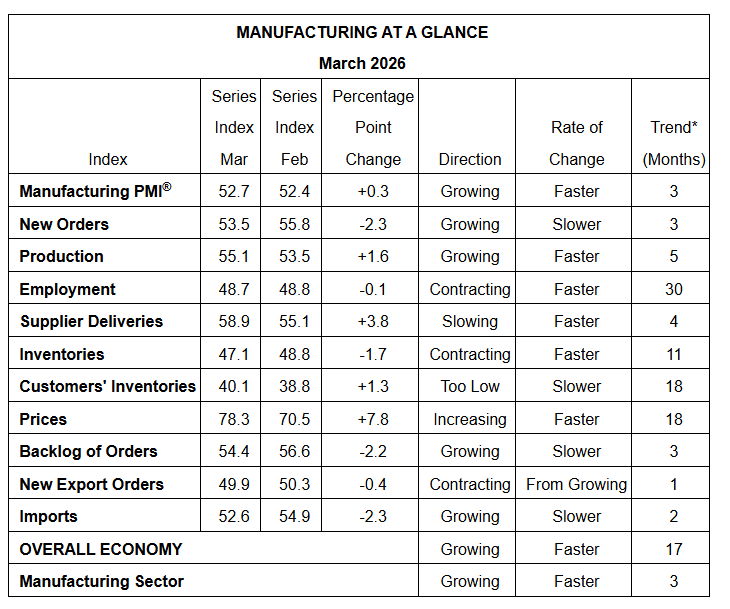
“The Manufacturing PMI registered 52.7 percent in March, a 0.3-percentage point increase compared to the reading of 52.4 percent in February. The overall economy continued in expansion for the 17th month in a row. (A Manufacturing PMI above 47.5 percent, over a period of time, generally indicates an expansion of the overall economy.) The New Orders Index expanded for the third straight month after four straight readings in contraction, registering 53.5 percent, down 2.3 percentage points compared to February’s figure of 55.8 percent. The March reading of the Production Index (55.1 percent) is 1.6 percentage points higher than February’s reading of 53.5 percent. The Prices Index remained in expansion (or ‘increasing’ territory), registering 78.3 percent, a 7.8-percentage point jump from February’s reading of 70.5 percent. In the last two months, the Prices Index has increased19.3 percentage points to reach its highest level since a reading of 78.5 percent in June 2022. The Backlog of Orders Index registered 54.4 percent, down 2.2 percentage points compared to the 56.6 percent recorded in February. The Employment Index registered 48.7 percent, down 0.1 percentage point from February’s figure of 48.7 percent.”
Spence continues, “In March, U.S. manufacturing activity remained in expansion territory, growing at a slightly faster pace than the month before. Of the five subindexes that make up the PMI®, the New Orders Index indicated slower growth compared to the previous month, the Production Index grew at a faster rate, and the Employment and Inventories indexes remained in contraction. This month also marks the first report with panelists citing the Iran war as a new impact to their business, along with ongoing uncertainty with U.S. economic policy, despite the recent Supreme Court ruling striking down International Emergency Economic Powers Act (IEEPA) tariffs. In March, 64 percent of comments overall were negative. Among the negative comments, about 20 percent cited tariffs and about 40 percent the war in the Middle East. (Some panelists referenced both topics within a single comment or in mixed sentiment.)
“Two demand indicators (the New Orders and Backlog of Orders indexes) are in expansion, the New Export Orders Index returned to contraction, and the Customers’ Inventories Index remains in ‘too low’ territory, contracting at a slightly slower rate. A ‘too low’ status for the Customers’ Inventories Index is usually considered positive for future production.
“Regarding output, the Production Index is in expansion for the fifth month in a row, and the Employment Index decreased by 0.1-percentage point and remains in contraction. Among panelists, 55 percent indicated that managing head counts remains the norm at their companies, as opposed to hiring.
“Finally, inputs (defined as supplier deliveries, inventories, prices and imports) had mixed results. The Supplier Deliveries Index indicated increasingly slowing deliveries, the Inventories Index contracted at a faster rate, and the Prices Index took another big leap — to 78.3 percent, from 70.5 percent in February. The Imports Index lost 2.3 percentage points for a reading of 52.6 percent, compared to 54.9 percent in February.
“Looking at the manufacturing economy, 16 percent of the sector’s gross domestic product (GDP) contracted in March, compared to 21 percent in February, and the percentage of manufacturing GDP in strong contraction (defined as a composite PMI of 45 percent or lower) increased to 4 percent, compared to 1 percent in February. The share of sector GDP with a PMI at or below 45 percent is a good metric to gauge overall manufacturing weakness. Of the six largest manufacturing industries, four (Transportation Equipment; Computer & Electronic Products; Machinery; and Chemical Products) expanded in March,” says Spence.
The 13 manufacturing industries reporting growth in March — listed in order — are: Printing & Related Support Activities; Primary Metals; Transportation Equipment; Miscellaneous Manufacturing; Electrical Equipment, Appliances & Components; Textile Mills; Computer & Electronic Products; Fabricated Metal Products; Machinery; Paper Products; Nonmetallic Mineral Products; Wood Products; and Chemical Products. The three industries reporting contraction in March are: Plastics & Rubber Products; Furniture & Related Products; and Food, Beverage & Tobacco Products.